


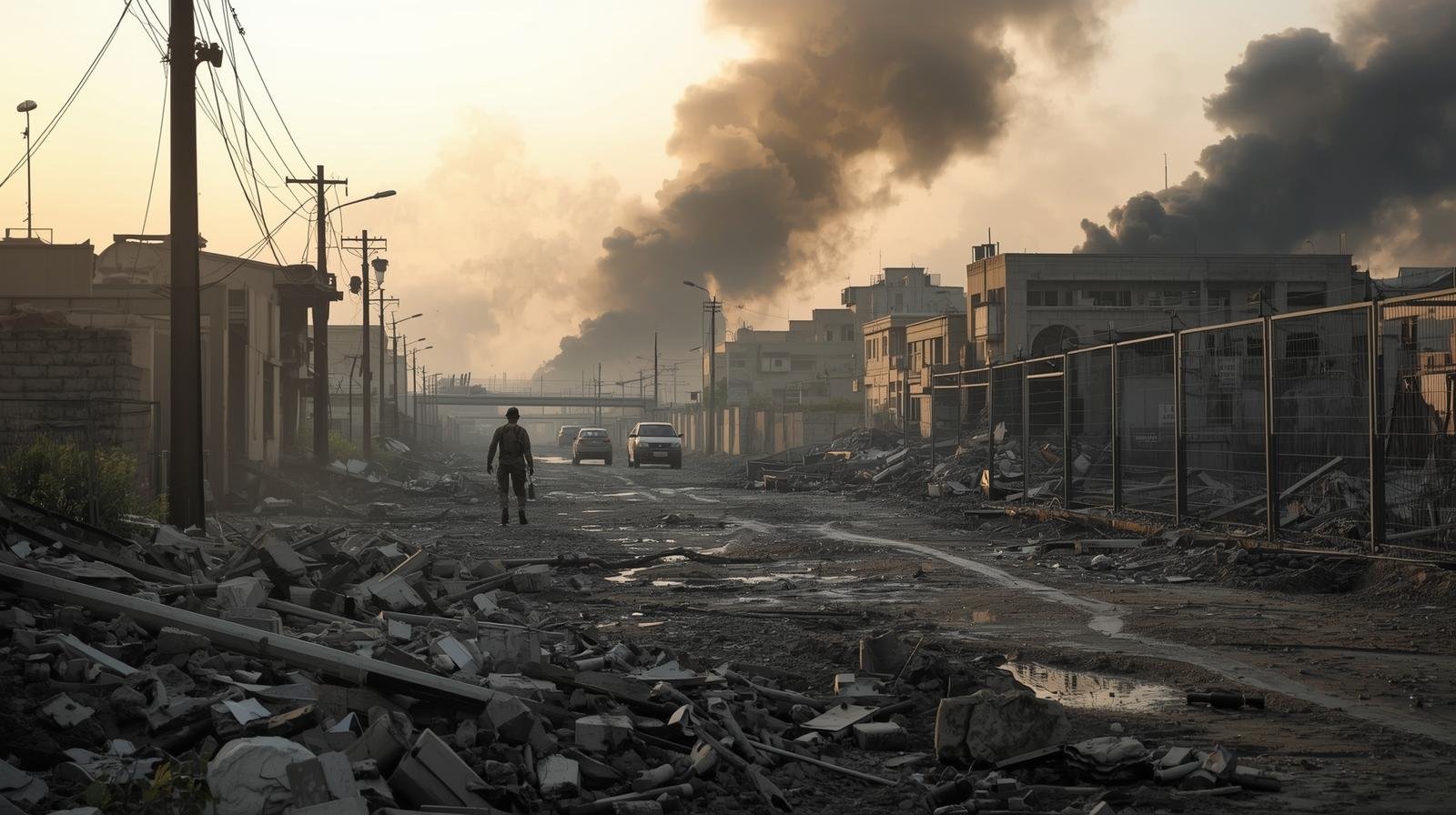
War and military conflict are human tragedies first and foremost. But investors still have to make decisions while the news is frightening and uncertainty feels sky-high. This article looks at what has typically happened to markets around major conflicts — and what the pattern can (and can’t) teach us.
The Starting Point Matters: The Backdrop Before Conflict
The economic and financial environment going into a conflict shapes how deeply markets fall and how quickly they recover. Ignoring this context leads to misleading comparisons.
Valuations and Bubbles
A war that erupts into an overvalued market — where price-to-earnings ratios (the price of a share relative to company profits) are stretched — will tend to cause a sharper and more prolonged drawdown (the peak-to-trough percentage fall). An already-cheap market has more cushion.
Inflation and Interest Rates
Elevated inflation heading into a conflict compounds the damage because it limits central banks’ ability to cut interest rates (their main tool for stimulating growth). The 1973 oil shock hit an economy already running hot; the resulting stagflation (simultaneous high inflation and low growth) was devastating for both bonds and equities.
Recession Risk and Earnings Trends
If corporate earnings are already under pressure, a geopolitical shock can tip an economy into recession. Conversely, a war striking during a period of strong economic activity and healthy corporate balance sheets may cause only a brief, shallow dip.
Energy and Commodity Exposure
Conflicts in or near major energy-producing regions — the Middle East, the Caspian, Eastern Europe — create supply shocks that ripple through every part of the economy. The energy-intensity of an economy at the time of conflict determines how badly it is affected.
Case Studies
All index returns below are price returns (excluding dividends) unless stated. The index used for each case study is noted. Historical data for early 20th-century conflicts carries limitations: trading halts, closed markets, and currency regimes differ from today’s conditions.
| Conflict | Start Date | Index Used | Initial Drawdown | Time to Recovery | 12-Month Return |
| Korean War | June 1950 | S&P 500 | -12.9% | 82 Days | +18.4% |
| Yom Kippur | Oct 1973 | S&P 500 | -17.1% | 6 Years | -33.2% |
| Gulf War | Aug 1990 | S&P 500 | -16.9% | 160 Days | +12.1% |
| 9/11 Attacks | Sep 2001 | S&P 500 | -11.6% | 31 Days | -18.0% |
| Iraq War | Mar 2003 | S&P 500 | -2.0% | 12 Days | +32.2% |
| Ukraine War | Feb 2022 | S&P 500 | -12.0% | 1.5 Years | -7.7% |
1. World War II (1939–1945) — Dow Jones Industrial Average (DJIA)
What happened: Germany invaded Poland on 1 September 1939, triggering a declaration of war by Britain and France. The US entered the conflict after Japan’s attack on Pearl Harbour on 7 December 1941.
Backdrop going in:
- The US economy was recovering from the Great Depression; unemployment remained elevated but declining
- Equity valuations were depressed by Depression-era pessimism — the market was arguably cheap
- Inflation was low; deflationary pressures had dominated the 1930s
- Government spending was already rising as rearmament began across Europe
Market reaction:
- The DJIA rose approximately 15% in the week following the European outbreak in September 1939, as investors priced in US industrial mobilisation
- Pearl Harbour triggered a brief dip of approximately 2.9%, which reversed within a month
- By the war’s end, the DJIA had risen approximately 50% overall
- One year after the WWII start date (1 September 1939): DJIA returned approximately -4.07%
Winners/losers:
- Winners: Defence manufacturing, steel, aviation, shipbuilding, small-cap industrials (small-cap stocks surged over 30% during the war)
- Losers: Consumer goods, luxury retail, international trade
What investors learned:
- Economic mobilisation creates powerful demand even amid terrible human cost
- A cheap, undervalued market entering a crisis shows resilience that an overvalued one does not
2. Korean War (1950–1953) — Dow Jones Industrial Average (DJIA)
What happened: North Korea invaded South Korea on 25 June 1950. The US and UN-allied forces entered the conflict within days.
Backdrop going in:
- The US economy was in a post-WWII expansion; employment was high and industrial capacity was strong
- Equity valuations were modest by historical standards
- Inflation had eased after the post-war spike, though commodity prices were sensitive
- The Cold War was already framing investor expectations around defence spending
Market reaction:
- Initial market drop was sharp but brief on the announcement of the invasion
- One year after the outbreak: DJIA returned approximately +14.67%
- Over three to five years, markets delivered strong double-digit gains
Winners/losers:
- Winners: Defence contractors, commodities (copper, steel, oil), US industrials
- Losers: Bonds (inflation risk), Asian-exposed exporters
What investors learned:
- Even an active, sustained land war on a strategically sensitive peninsula did not derail a broadly healthy economy
- The market’s 12-month return of nearly 15% following the invasion is one of the strongest in any conflict year on record
3. Vietnam Era and the 1973 Oil Shock — Dow Jones Industrial Average (DJIA)
What happened: US military escalation in Vietnam accelerated from 1965. The Yom Kippur War (October 1973) triggered an OPEC oil embargo against nations supporting Israel, quadrupling oil prices and unleashing an energy crisis across the Western world.
Backdrop going in:
- Vietnam was draining US government finances; the fiscal deficit was widening
- President Nixon closed the “gold window” in August 1971 — ending the Bretton Woods system of fixed exchange rates — creating monetary instability
- Inflation was already rising before the oil shock; the 1973 embargo amplified a pre-existing problem
- Equity valuations had become stretched by the early 1970s “Nifty Fifty” boom (a group of high-growth US companies commanding very high valuations)
Market reaction:
- Escalation of Vietnam in 1965: one-year DJIA return approximately +8.83%
- The DJIA posted an overall gain of approximately 43% during the Vietnam era (1965–1973), averaging roughly 5% per year — but this disguises enormous volatility
- Following the 1973 oil embargo: the DJIA fell nearly 45% peak-to-trough between 1973 and 1974 — one of the worst bear markets of the 20th century
- Full recovery to prior highs took several years
Winners/losers:
- Winners (1973–74): Oil majors, gold, commodities
- Losers: Virtually everything else; consumer stocks, transport, and the “Nifty Fifty” growth stocks collapsed
What investors learned:
- When a conflict exacerbates an existing inflation and monetary instability problem, the combined effect can be catastrophic
- The 1973 experience introduced a generation of investors to energy and commodity investing as a portfolio defence
4. Gulf War (1990–1991) — S&P 500
What happened: Iraq invaded Kuwait on 2 August 1990. Operation Desert Storm — the US-led coalition counteroffensive — began on 16 January 1991 and concluded with a ceasefire within 100 hours of ground combat.
Backdrop going in:
- The US was entering a mild recession; the S&P 500 had already pulled back before the invasion
- Oil prices were relatively stable at $15–$20 per barrel prior to the invasion
- Interest rates were high (the Fed funds rate was around 8%); inflation was moderate at around 5%
- Corporate earnings growth was slowing but not collapsing
Market reaction:
- S&P 500 fell approximately 10–15% in the weeks following the invasion, through to early autumn 1990
- When Operation Desert Storm commenced in January 1991, markets rallied immediately — the uncertainty premium dissolved
- One year after Desert Storm began: DJIA returned approximately +29.52%
- Oil spiked to approximately $40 per barrel before collapsing as swiftly as it had risen
Winners/losers:
- Winners: Defence, oil producers (briefly), US Treasuries as a safe haven during the uncertainty phase
- Losers: Airlines, travel, consumer stocks; oil consumers (refiners, industrials) short-term
What investors learned:
- The Gulf War is the textbook example of markets pricing uncertainty, not just danger. Once the conflict’s shape was clear, markets rallied decisively
- The swift military resolution meant oil’s spike was short-lived — the energy shock did not become a regime-level inflation problem
5. Post-9/11 and the Iraq War (2001/2003) — S&P 500
What happened: The 11 September 2001 terrorist attacks triggered a market closure for four days — the longest since 1933. The US-led invasion of Iraq began on 19 March 2003.
Backdrop going in (2001):
- The dot-com bubble had already burst; the Nasdaq had fallen roughly 70% from its peak
- The S&P 500 was in a bear market before 9/11; the economy was in or near recession
- Interest rates were already being cut aggressively by the Federal Reserve
- Valuations were falling but remained elevated relative to historical norms
Market reaction (9/11):
- On reopening, the DJIA fell approximately 7.1% on the first day
- The S&P 500 fell approximately 12% in the following week before recovering
- Recovery to pre-attack levels took approximately 15 trading days
- One-year DJIA return after 9/11: approximately -3.81% — though this largely reflected the pre-existing bear market, not the attack alone
Market reaction (Iraq War 2003):
- Pre-war uncertainty weighed on equities in the months before the invasion
- When the invasion began, markets rallied sharply — the “buy the rumour, sell the fact” dynamic in reverse: sell the rumour, buy the news
- One-year DJIA return after the invasion started: approximately +23.24%
Winners/losers:
- Winners: Defence, homeland security, aerospace, oil
- Losers: Airlines (catastrophically), travel, insurance (short-term)
What investors learned:
- The 9/11 recovery speed — back to prior levels in 15 trading sessions — illustrates how resilient a liquid, diversified market can be to even catastrophic one-off shocks
- Pre-war anxiety proved a heavier burden on valuations than the war itself
6. Russia–Ukraine War (2022–present) — S&P 500 / MSCI Europe
What happened: Russia invaded Ukraine on 24 February 2022 — the first major land war in Europe since 1945 — triggering sweeping Western sanctions and a dramatic reconfiguration of European energy supply.
Backdrop going in:
- US and global equity valuations were at historically elevated levels following a decade of ultra-low interest rates
- Inflation was already rising sharply going into 2022; Western central banks were behind the curve
- Energy dependence on Russian gas was acute across continental Europe
- The Federal Reserve and Bank of England were about to embark on the most aggressive rate-hiking cycle in 40 years
Market reaction:
- S&P 500 fell approximately 5–8% in the weeks following the invasion
- MSCI Europe fell more sharply, reflecting energy exposure
- Full 2022 S&P 500 bear market: approximately -25% peak-to-trough — but driven predominantly by rate hikes and inflation, not the war itself
- One-year DJIA return after the invasion: approximately -1.22%
Winners/losers:
- Winners: European defence stocks, energy majors, commodities (wheat, fertilisers, natural gas)
- Losers: European industrials, emerging markets with commodity import dependency, growth equities (hurt more by rates)
What investors learned:
- Attributing 2022’s bear market to Ukraine alone misreads the evidence; the macro backdrop (inflation and rate hikes) was the dominant driver
- Europe’s energy dependency was a portfolio risk long before February 2022; investors who had not stress-tested this exposure were caught out
Recurring Patterns
Across these case studies, several patterns emerge consistently — not as iron laws, but as tendencies worth understanding:
1. Markets price uncertainty, not just danger. The period before a conflict often inflicts more damage than the conflict’s announcement. Once the fog lifts — however grimly — investors can model outcomes and valuations stabilise. The Gulf War and Iraq War both demonstrate this with unusual clarity.
2. The “sell the rumour, buy the fact” dynamic. Anticipatory anxiety is frequently overpriced relative to the actual economic impact of the event.
3. Recoveries are faster than intuition suggests. Across the major post-1945 conflicts, the S&P 500 was higher one year after the onset of conflict approximately 70% of the time, with average one-year returns in the high single digits. An average geopolitical shock produces a market decline of roughly 5.1%, recovered in an average of around 47 trading days.investopedia+1
4. Energy and supply chains are the most important factors. Conflicts that disrupt energy supply — 1973, 1990, 2022 — cause the deepest and most persistent economic pain, because energy costs flow through to everything else.
5. Safe havens are conditional, not absolute. Gold has averaged an 8.98% gain over the 12 months following major conflicts. But during the 2025 Israel-Iran escalation, gold fell 3.17% as equities rallied instead — rapid conflict resolution removed its crisis premium. The Swiss franc has appreciated against the US dollar in every major conflict analysed — making it a more consistent, if less discussed, safe haven. The US dollar itself averaged a slightly negative 1-month performance during conflicts (-0.19%), challenging the assumption of automatic dollar strength.
Sources and Further Reading
- Nedbank Private Wealth: “How war affects markets and what investors can learn from history” (2025) — DJIA event returns table
- Findex: “How do share markets perform during conflicts?” (2025) — conflict-by-conflict index returns
- DIY Investor / Investors Observer: “The performance of safe haven assets during geopolitical conflicts” (2025) — gold, DXY, CHF, Bitcoin data
- Focus Partners: “Geopolitical Conflict and Markets: A Brief History Lesson” (2026) — average drawdown and recovery statistics
- Investopedia: “Impact of War on Stock Markets: Investor Insights and Trends” (2025) — WWII/Korea context
- Invesco: “Markets in War Time” (research paper — Invesco Education Series) — broader academic framing
- Schwab: “Geopolitical Risk is Evolving: What You Should Know” (2026) — modern market structure considerations
Further reading:
- MSCI: Geopolitical Risk and Financial Markets (available at msci.com)
- BlackRock Investment Institute: Geopolitical Risk Dashboard
- BIS Working Papers on conflict and asset prices



0 Comments