


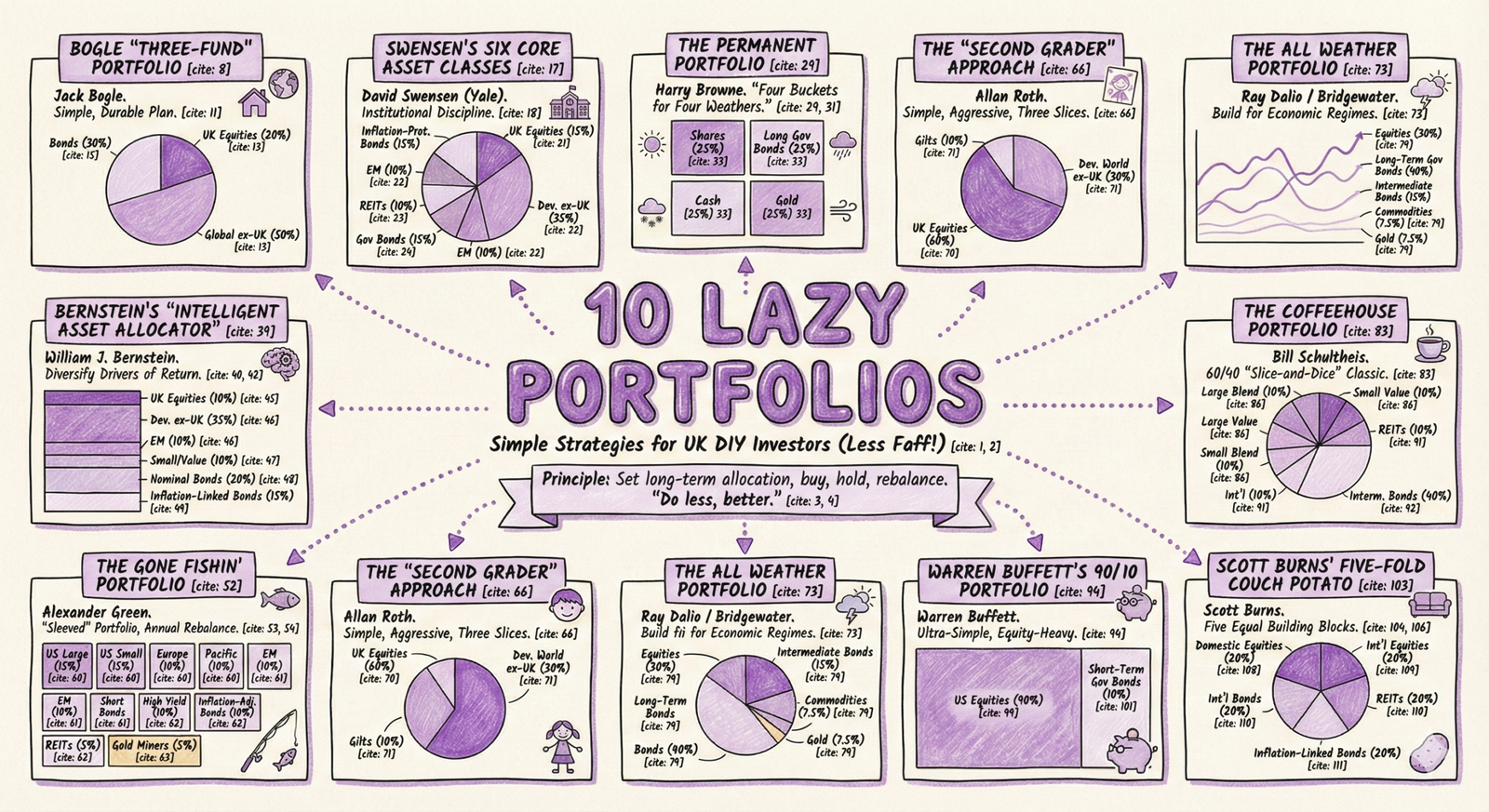
Lazy Portfolios: simple strategies (for UK DIY investors)
Lazy portfolios are built on one powerful principle: set a long-term asset allocation you can live with, then mostly buy, hold, and rebalance rather than react to noise.
This “do less, better” approach is backed by behavioural finance: research such as Barber & Odean’s Boys Will Be Boys links overconfidence to higher trading, and higher trading tends to mean more costs and more mistakes — a drag on returns.
The good news is there isn’t just one lazy portfolio; there are several well-known templates (Bogle, Swensen, Browne, Bernstein, Green, Dalio, Schultheis, Buffett, Burns). This article lays out the main approaches for UK investors, shows their suggested allocations, and explains how to think about building them.
1) The Bogle “Three-Fund” Portfolio — broad, low-cost, and boring (in a good way)
Commentary
Jack Bogle (founder of Vanguard) argued that most investors are best served by owning the market through low-cost index funds and staying the course. The “three-fund” template (popularised by the Bogleheads community) turns that into a simple, durable plan: home equities, overseas equities, and high‑quality bonds — rebalanced back to target.
The three fund portfolio, discusses US portfolios, international exposure and bonds. For UK investors, we have changed this to UK and global exposure.
Asset allocation (example)
| Asset class | Example allocation | UK building block (category) |
|---|---|---|
| UK equities (home market) | 20% | UK all‑share / FTSE-type tracker |
| Global equities ex‑UK | 50% | Developed ex‑UK equity tracker (optionally add a separate EM tracker if you prefer) |
| Bonds (defensive ballast) | 30% | Gilts and/or GBP‑hedged global aggregate bonds |
Further reading
- 📚 Jack Bogle — The Little Book of Common Sense Investing
- 📚 The Bogleheads’ Guide to the Three-Fund Portfolio: How a Simple Portfolio of Three Total Market Index Funds Outperforms Most Investors with Less Risk
2) Swensen’s six core asset classes
Commentary
David Swensen (long-time CIO of Yale’s endowment) wrote Unconventional Success to translate institutional discipline into something individuals could run: get the asset allocation right, keep costs low, diversify properly, and stay invested. A practical way he framed this was via six core asset classes: domestic equity, developed foreign equity, emerging markets, REITs, high‑quality government bonds, and inflation‑protected bonds (UK translation: UK equities, developed ex‑UK equities, EM equities, global REITs, gilts/global government bonds, and UK index‑linked gilts).
Asset allocation (suggested portfolio — example)
| Core asset class (UK translation) | Example allocation | UK building block (category) |
|---|---|---|
| Domestic equity (UK equities) | 15% | UK all‑share / FTSE-type tracker |
| Foreign developed equity (developed ex‑UK) | 35% | Developed world ex‑UK equity tracker |
| Emerging market equity | 10% | Emerging markets equity tracker |
| REITs (listed property) | 10% | Global REIT/property tracker |
| Government bonds (high quality) | 15% | Gilts and/or global government bonds (often GBP‑hedged) |
| Inflation‑protected bonds | 15% | UK index‑linked gilts (and/or global inflation‑linked bonds) |
Further reading
- Brickley Wealth — “Breaking Down the Success of Unconventional Success” (https://www.brickleywealth.com/learn/breaking-down-the-success-of-unconventional-success-by-david-swensen)
- 📚 David Swensen — Unconventional Success: A Fundamental Approach to Personal Investment
3) The Permanent Portfolio (Harry Browne) — “Four buckets for four weathers”
Commentary
Harry Browne developed the Permanent Portfolio as a “stay invested, whatever happens” framework. Instead of guessing the future, it spreads your money equally across four assets chosen to do well in different economic conditions: prosperity, deflation, tight‑money/recession, and inflation.
The rationale is to cover multiple regimes so you’re less dependent on any one forecast — and less tempted to bail out at the wrong time.
The classic Permanent Portfolio is 25% each in stocks, long-term government bonds, cash (T-bills), and gold, rebalanced annually.
Asset allocation (classic)
| Sleeve | Allocation | UK translation (category) |
|---|---|---|
| Shares | 25% | Global equity tracker |
| Long government bonds | 25% | Long-dated gilts |
| Cash / short-term | 25% | Money market / short gilts / cash-like fund |
| Gold | 25% | Gold ETC/ETP exposure |
Further reading
- Harry Browne — Fail-Safe Investing (and his Permanent Portfolio essays)
- 📚 Craig Rowland & J.M. Lawson — The Permanent Portfolio
4) Bernstein’s “Intelligent Asset Allocator” approach — diversify the drivers of return
Commentary
William J. Bernstein (neurologist-turned-investment-writer) wrote The Intelligent Asset Allocator to answer a practical question: how do you build a portfolio that maximises long-term return for the amount of risk you’re willing to take?
His rationale is rooted in mainstream portfolio theory: different asset classes don’t move in lockstep, so combining them can improve your risk-adjusted outcome. The goal isn’t to predict markets. It’s to spread your bets across distinct sources of return (global equities, smaller-company risk, emerging markets, nominal and inflation-linked bonds), then rebalance back to plan.
In plain English: you set a strategic allocation that matches your risk tolerance, diversify broadly, keep costs low, and let the maths of diversification do its job.
Asset allocation (Bernstein-style example)
| Asset class | Example allocation | UK building block (category) |
|---|---|---|
| UK equities | 10% | UK all‑share / FTSE-type tracker |
| Developed world ex‑UK equities | 35% | Developed world ex‑UK tracker |
| Emerging markets equities | 10% | Emerging markets tracker |
| Global small-cap / value tilt | 10% | Global small-cap and/or value equity fund (keep this sleeve small) |
| High-quality nominal bonds | 20% | Gilts and/or GBP‑hedged global aggregate bonds |
| Inflation‑linked bonds | 15% | UK index‑linked gilts (and/or global inflation‑linked bonds) |
Further reading
- 📚 William J. Bernstein — The Intelligent Asset Allocator: How to Build Your Portfolio to Maximize Returns and Minimize Risk
- 📚 William J. Bernstein — The Four Pillars of Investing (useful companion on theory + behaviour)
5) The Gone Fishin’ Portfolio (Alexander Green) — “10 sleeves, annual rebalance”
Commentary
Alexander Green (a long-time investment writer, often associated with The Oxford Club) proposed the Gone Fishin’ Portfolio for investors who want broad diversification without constant decision-making. It’s a “sleeved” portfolio: several regional equity chunks, a small property and gold‑miners slice, and a bond mix that includes inflation protection, short duration, and higher‑yield credit.
The rationale: you spread risk across multiple markets and bond types, but keep the rules simple — stick to the weights and rebalance annually.
UK translation note (before you build it): the original is US‑centric, but the sleeves map neatly to UK ISA/SIPP building blocks: regional equity trackers (US large/small, Europe, Pacific, EM), plus global REITs, inflation‑linked gilts, short‑duration investment‑grade bonds, global high yield, and a gold‑miners equity sector fund.
Asset allocation (classic Gone Fishin)
| Sleeve (plain English) | Allocation |
|---|---|
| US large cap equities | 15% |
| US small cap equities | 15% |
| Europe equities | 10% |
| Pacific equities | 10% |
| Emerging markets equities | 10% |
| Short-term bonds (often investment-grade) | 10% |
| High-yield bonds | 10% |
| Inflation-adjusted bonds | 10% |
| REITs / property securities | 5% |
| Gold miners equities | 5% |
Further reading
- The Oxford Club — “The Gone Fishin’ Portfolio”
- 📚 Alexander Green — “Gone Fishin’ Portfolio”
6) The “Second Grader” approach (Allan Roth) — simple, aggressive, three slices
Commentary
Allan Roth popularised the “second grader” idea to make a point: investing doesn’t need to be complicated to work. By focusing on broad index exposure, keeping costs down, and resisting the urge to trade, a very simple allocation can beat many “clever” portfolios once behaviour and fees are accounted for.
The rationale: simplicity reduces the chance you’ll make unforced errors — especially during market stress.
Asset allocation (example)
| Asset class | Allocation |
|---|---|
| UK equities | 60% |
| Developed world ex-UK equities | 30% |
| Gilts | 10% |
Further reading
- 📚 Allan Roth — How a Second Grader Beats Wall Street: Golden Rules Any Investor Can Learn
- Monevator — “9 lazy portfolios for UK passive investors” (it features Roth-style allocations): https://monevator.com/9-lazy-portfolios-for-uk-passive-investors-2010/
7) The All Weather Portfolio (Ray Dalio / Bridgewater) — build for economic regimes
Commentary
Ray Dalio and Bridgewater popularised the “All Weather” idea as a way to stay invested through different market environments. Rather than making one big bet, the approach aims to hold assets that respond differently when growth and inflation rise or fall.
A key part of the thinking is risk balance (often associated with “risk parity”): bonds are lower-volatility than equities, so a diversified portfolio may hold more bonds by capital weight than a traditional 60/40.
Asset allocation (widely cited approximation — example)
Note: Bridgewater hasn’t published a single official “DIY recipe”, but the mix below is a commonly referenced approximation used in many explainer articles.
| Asset class | Allocation | UK building block (category) |
|---|---|---|
| Equities (growth) | 30% | Global all-world equity tracker |
| Long-term government bonds (deflation hedge) | 40% | Long-dated gilts / long-duration government bond fund |
| Intermediate-term government bonds | 15% | Intermediate gilts / intermediate-duration government bond fund |
| Commodities (inflation hedge) | 7.5% | Broad commodities ETC/ETP exposure |
| Gold (inflation/monetary stress) | 7.5% | Gold ETC/ETP exposure |
Further reading
- Bridgewater — “The All Weather Story”: https://www.bridgewater.com/research-and-insights/the-all-weather-story
- Saxo — “The Ray Dalio ‘All Weather’ Portfolio – A Guide for Investors”: https://www.home.saxo/en-gb/content/articles/equities/all-weather-portfolio-27082025
8) The Coffeehouse Portfolio (Bill Schultheis) — a 60/40 “slice-and-dice” classic
Commentary
Bill Schultheis (author of The Coffeehouse Investor) popularised the Coffeehouse Portfolio as a simple way to capture broad market returns while adding modest diversification across equity styles (blend/value, large/small) and a small property sleeve.
The rationale is behavioural and practical: keep the structure stable (a fixed long-term allocation), rebalance occasionally, and avoid chasing whatever Wall Street is selling this year.
Asset allocation (classic Coffeehouse — example)
| Asset class | Allocation | UK building block (category) |
|---|---|---|
| Large-cap equities (blend) | 10% | Broad developed equity tracker (large-cap dominated) |
| Large-cap value equities | 10% | Value equity fund/ETF (keep costs sensible) |
| Small-cap equities (blend) | 10% | Small-cap equity fund/ETF |
| Small-cap value equities | 10% | Small-cap value equity fund/ETF |
| International equities (developed) | 10% | Developed ex-UK equity tracker |
| REITs (listed property) | 10% | Global REIT/property tracker |
| Intermediate-term bonds | 40% | Gilts and/or GBP-hedged global aggregate bonds |
Further reading
- Bill Schultheis — The Coffeehouse Investor
- Portfolio Charts — Coffeehouse Portfolio (includes the classic weights): https://portfoliocharts.com/portfolios/coffeehouse-portfolio/
- Logical Invest — Coffeehouse Portfolio overview (clear 60/40 breakdown): https://logical-invest.com/app/portfolio/coffee/coffeehouse-portfolio
9) Warren Buffett’s 90/10 portfolio — ultra-simple, equity-heavy
Commentary
Warren Buffett has repeatedly argued that most investors will do better with low-cost index funds than by paying high fees to active managers. In Berkshire Hathaway’s 2013 shareholder letter, he described instructions in his will for money held in trust for his wife: keep it simple, keep costs low, and let the US equity market do the work.
The rationale is straightforward: 90% equities for long-term growth, plus 10% short‑term government bonds as a stability and liquidity sleeve.
Asset allocation (Buffett 90/10)
| Asset class | Allocation | UK building block (category) |
|---|---|---|
| US equities (S&P 500) | 90% | S&P 500 UCITS ETF / S&P 500 index fund (inside an ISA/SIPP) |
| Short-term government bonds | 10% | Short-dated gilts / cash-like government bond fund |
Further reading
- Berkshire Hathaway — 2013 shareholder letter (PDF): https://www.berkshirehathaway.com/letters/2013ltr.pdf
- Fidelity UK — “Generate your retirement income the Warren Buffett way”: https://www.fidelity.co.uk/markets-insights/personal-finance/saving-for-retirement/generate-your-retirement-income-the-warren-buffett-way/
10) Scott Burns’ Five-Fold Couch Potato portfolio — five equal building blocks
Commentary
Scott Burns popularised the “Couch Potato” idea to show that a diversified, low-cost portfolio can be easy to run and hard to sabotage. The Five‑Fold version is a “slice-and-dice” step up: it uses five equal 20% sleeves to add diversifiers (property and inflation‑linked bonds) alongside equities and bonds — then you periodically rebalance back to equal weights.
Asset allocation (Five-Fold — classic weights)
| Sleeve | Allocation | UK building block (category) |
|---|---|---|
| Domestic equities (US in the original) | 20% | US total market / S&P 500 UCITS equity fund (or a UK equity sleeve if you prefer “home” to mean UK) |
| International equities (ex‑US in the original) | 20% | Developed ex‑UK (and/or global ex‑US) equity tracker |
| REITs (listed property) | 20% | Global REIT/property tracker |
| Inflation‑linked bonds (TIPS in the original) | 20% | UK index‑linked gilts (and/or global inflation‑linked bonds) |
| International bonds (non‑US) | 20% | Global bonds (often GBP‑hedged) / global ex‑UK bonds sleeve |
Further reading
Canadian Couch Potato — interview with Scott Burns (background on the approach): https://canadiancouchpotato.com/2012/02/20/an-interview-with-the-original-couch-potato/
Scott Burns — Couch Potato Investing archive: https://scottburns.com/category/couch-potato-investing/
Portfolio Einstein — allocations for Burns’ “other Couch Potato portfolios” (includes Five‑Fold): https://portfolioeinstein.com/scott-burns-the-8-other-couch-potato-portfolios/
Disclaimer: This is educational information, not personal financial advice.



0 Comments