Retirement planning sounds like one you make your fifties. In reality, it is dozens of smaller decisions spread across decades: how much to save, where to invest it, when to lean on a pension versus an ISA, how much risk to carry, and eventually, how to turn a pot of money into an income that lasts as long as you do.
This post provides an age-by-age structure for a UK investor, considering workplace pensions, SIPPs, ISAs, the State Pension, tax-free cash, drawdown and annuities instead of 401(k)s and IRAs.
A reminder, this is educational content, not personal financial advice. The right approach depends on your income, tax position, pension arrangements, health and appetite for risk.
The Building Blocks Everyone Should Know
Before diving into ages and decades, it is worth being clear on the main tools UK savers have, because most later decisions are really just choices about which of these to use, and when.
Workplace pensions are usually the sensible starting point, particularly because employer contributions are effectively extra pay. Opting out means turning down free money. Personal pensions and SIPPs extend that idea, offering more control over fund choice and extra capacity for the self-employed or higher earners who want to save beyond their workplace scheme.
ISAs remain the flexible workhorse of UK saving — the annual allowance sits at £20,000, according to GOV.UK’s ISA guidance[web:1]. For younger savers building towards a first home, a Lifetime ISA allows contributions of up to £4,000 a year until age 50, provided the first payment is made before age 40.
The full new State Pension currently pays £241.30 a week, though the amount depends heavily on your National Insurance record and any transitional rules.
Most pension savers can still take 25% of their pot tax-free, subject to an overall lump sum allowance of £268,275 unless specific protections apply. And the standard annual allowance for pension contributions is £60,000 — though this can shrink for high earners or anyone who has already accessed pension benefits.
With those building blocks in place, here is what tends to matter most at each stage of life.
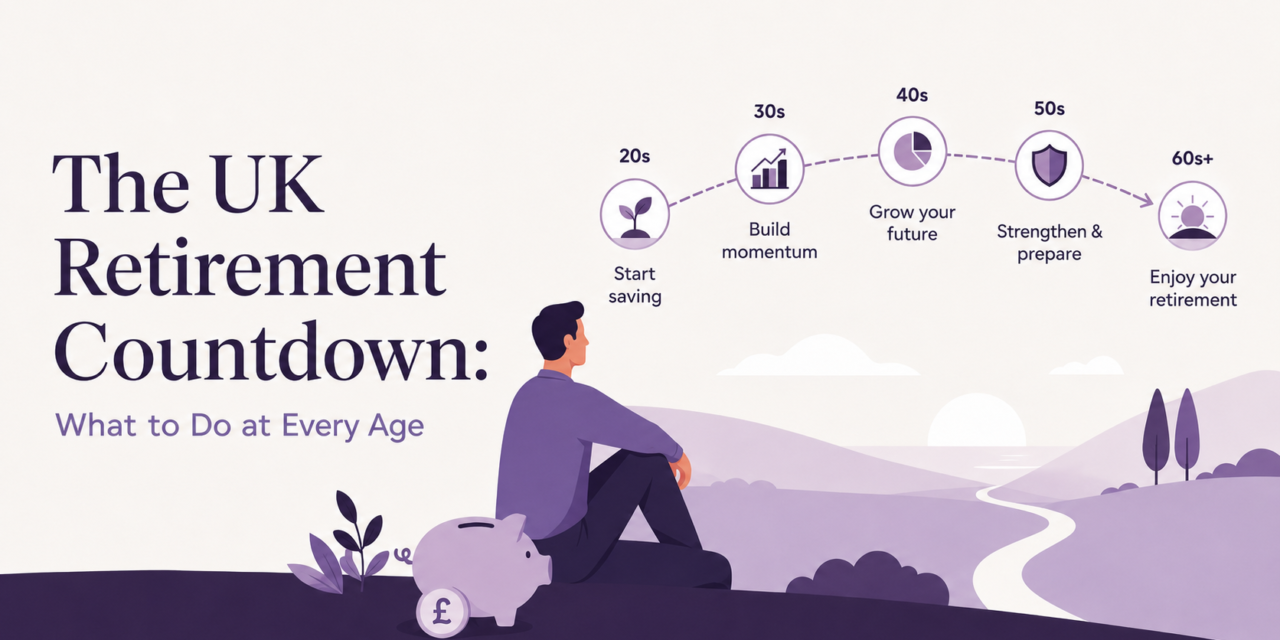
Your 20s and 30s: Build the Habit
The single biggest advantage a younger investor has is time, and time is not something you can buy back later. Modest monthly contributions, invested consistently for several decades, can compound into genuinely large sums not through brilliance, but through patience.
At this stage, the priority is joining a workplace pension scheme and contributing enough to capture the full employer match, since that is usually the single highest-return decision available to any employee. Use your capacity for risk while you have it: with decades until retirement, market falls are uncomfortable but often become buying opportunities in hindsight rather than disasters.
A pension is a brilliant long-term tool, but it is for long term money. Build an emergency fund alongside it, and consider opening a Stocks and Shares ISA as a more accessible companion to your pension, ISA money can be reached if you need it.
A Lifetime ISA can help too, particularly towards a first home, but read the withdrawal rules carefully before committing, since using the money outside its permitted purposes triggers a penalty.
The takeaway: in your early investing years, simple beats sophisticated. Automate contributions, invest globally, keep costs low, and resist the urge to tinker.
Your 40s: Build your pension, when you can
If your 20s and 30s were about building a habit, your 40s are about making adding to your pension in possibly some of your good earning years. Although this is often the decade where competing priorities collide mortgages, children, career, parents, all while retirement is a future event.
Start by estimating a rough number: what might you need to spend in retirement, and are your pensions, ISAs and State Pension entitlement broadly on track to support that? You do not need to be precise, just start to approximate. Look at the tools section on our website to help you. It is also worth checking your State Pension forecast directly, because GOV.UK is explicit that your State Pension age can differ from the age at which you can access workplace or personal pensions.
Your future income is still one of your largest assets, so protecting your ability to earn through insurance, also matters as much as any investment decision. Revisit your asset allocation so it reflects your actual time horizon rather than last year’s headlines. Use pensions and ISAs together, as both offer different Tax benefits.
The takeaway: your 40s are when good intentions need to become a plan, not complicated, just something that shows what you’re saving, where it’s invested, and what income you’re aiming for.
Your 50s: Close the Gap
Your 50s are typically peak-earning years, and often the last real window to make a meaningful difference to your retirement readiness. This is where pension mechanics start to matter more, and where a few careless moves can be expensive.
If you can afford it, this is a natural decade to increase pension contributions, given the £60,000 annual allowance. Watch the tapered annual allowance too, which for 2026–27 can bite where threshold income exceeds £200,000 and adjusted income exceeds £260,000, be careful not to accidentally trigger the money purchase annual allowance (MPAA), which restricts future pension saving to £10,000 after certain flexible withdrawals.
This is also a good time to track down old workplace pensions and check their charges, fund choices and retirement options pots from a decade-old job are easy to lose track of.
Think through mortgage strategy too: entering retirement mortgage-free reduces income pressure, though overpaying a mortgage is not automatically better than investing via a pension or ISA. And really consider the investment risk because retirement feels closer you do not have to remove the risk from all your pension, a 60 year old may still be investing for another 30 years.
The takeaway: More detailed planning is now required, an understanding of expected income, how much capital that requires and then setting contributions accordingly.
The Final Decade: Rehearse the Lifestyle
In the five to ten years before retirement, the plan stops being theoretical. It is no longer just about the size of your pot — it is about how that pot will actually support your life.
Build a proper retirement budget covering essential spending, lifestyle spending, one-off costs and later-life contingencies, and then try living on your projected retirement income for a few months before you actually retire. It is a quick, honest way to test whether the plan feels realistic rather than merely looks realistic on a spreadsheet. Map out which income sources arrive at which age, since pensions, ISAs, cash, part-time work, rental income and the State Pension rarely all switch on simultaneously.
GOV.UK confirms that uncrystallised pension lump sums paid from 6 April 2028 will generally require savers to have reached the new normal minimum pension age of 57, so check your own access age carefully. Decide how much cash to hold in reserve too, since a sensible buffer reduces the need to sell investments during a downturn, and do not neglect the emotional side.
The takeaway: This is where the numbers become real, so understand your potential drawdown strategy. Have a liquidity fund to draw down, or have part of your pension in liquid and safer assets which you can use to drawdown, Then consider when you will need the remainder of your pension money, if it is in 10 or 20 years time, consider this when setting your asset allocaiton.
At Retirement: Turn Wealth Into Income
Retirement marks the point where accumulation becomes decumulation. The question quietly changes from “how do I grow this?” to “how do I use this without running out too soon?” — and this is one of hardest parts of retirement.
For years you have saved your money and now you are going to spend it.
Your withdrawal strategy matters enormously here. Drawdown offers flexibility but keeps investment risk squarely with you, while annuities trade that flexibility for guaranteed income. Be deliberate about tax bands too: pension withdrawals above your tax-free cash are usually taxable income, whereas ISA withdrawals remain tax-free, which makes the order you draw from different pots genuinely important. Resist taking your 25% tax-free lump sum automatically just because you can — without a plan, it can simply move money out of a tax-sheltered pension into a less protected environment. Coordinate everything with the State Pension, which behaves like an inflation-linked income floor but may not start at the same time as your private pension access. Then review the whole arrangement at least once a year, because spending, markets, inflation, health and tax rules all shift over time.
The takeaway: retirement income planning is a balancing act — enough growth to fight inflation, enough caution to sleep at night, and enough flexibility to adapt as circumstances change.
Later Retirement: Protect Resilience
Later in retirement, the priority quietly shifts from maximising returns to protecting resilience. The risks are no longer just market volatility — they extend to inflation, care needs, cognitive decline, fraud and estate planning.
Simplifying your portfolio becomes valuable here, since complicated holdings can become a burden if health or confidence declines. Document the plan clearly enough that a spouse, partner or trusted family member knows where accounts sit and how it works, keep powers of attorney updated, and review pension nominations, will and estate plan for consistency. Think honestly about later-life care costs too — uncertain, but ignoring them entirely can leave family with difficult decisions at the worst time.
The takeaway: a good later-life plan is not just tax-efficient. It is understandable, manageable and resilient if life becomes more complicated than expected.
Your Annual Retirement Checklist
Use this as a quick yearly health check on your own plan:
- Am I contributing enough to capture my full employer pension match?
- Am I at risk of exceeding my pension annual allowance?
- Am I using my ISA allowance where it makes sense?
- Does my asset allocation still match my time horizon and risk tolerance?
- Are my platform, fund and advice costs reasonable?
- Have I checked my State Pension forecast and National Insurance record?
- Have I tracked down and reviewed any old workplace pensions?
- Do I hold enough cash for emergencies and planned withdrawals?
- Do I know roughly what my desired retirement lifestyle would cost?
- Are my will, pension nominations and powers of attorney up to date?
The biggest mistake I see
After years of reviewing different pension schemes the biggest mistake I see is in asset allocation of different pension schemes.
Many schemes, will automatically de-risk and buy bonds, in the run up to what the scheme thinks will be your retirement date.
But you may have different plans and ideas. I saw this particularly in 2022, where Bonds fell in value after the inflation scare and many people approaching retirement saw the value of their pension fall dramatically, some even had to carry on working.
What can you do ? My view is to take control of your pension, consolidate this into one scheme, and either take professional advice or set an asset allocation which matches your own personal retirement plan.
If you do anything after reading this, my recommendation, is to check and understand how your different pension schemes are invested.
Building Your Own Plan
If you want to start building your own version of this plan, begin simply: list your pensions, ISAs, cash savings, expected State Pension and target retirement age, then compare what you already have against the lifestyle you actually want. The gap between those two numbers is the real work of retirement planning, everything else in this post is just the toolkit for closing it.
At Clearly Investments, the aim is always to help DIY investors understand the choices, trade-offs and tax wrappers behind long-term financial independence. Retirement planning rewards patience and consistency far more than it rewards cleverness, and that is arguably the most reassuring thing about it.
This article is for general educational purposes only and does not constitute personal financial advice. Tax treatment depends on individual circumstances and may change. Pension and ISA figures reflect GOV.UK guidance at the time of writing. Investments can fall as well as rise, and you may get back less than you put in — consider speaking to a regulated financial adviser before acting on anything above.
Sources:
- GOV.UK — Individual Savings Accounts (ISAs): https://www.gov.uk/individual-savings-accounts
- GOV.UK — Lifetime ISA: https://www.gov.uk/lifetime-isa
- GOV.UK — The new State Pension: What you’ll get: https://www.gov.uk/new-state-pension/what-youll-get
- GOV.UK — Taking higher tax-free lump sums with lifetime allowance protection: https://www.gov.uk/guidance/taking-higher-tax-free-lump-sums-with-lifetime-allowance-protection
- GOV.UK — Tax on your private pension contributions: Annual allowance: https://www.gov.uk/tax-on-your-private-pension/annual-allowance
- GOV.UK — Check your State Pension age: https://www.gov.uk/state-pension-age
- GOV.UK — Rates and allowances: Pension schemes: https://www.gov.uk/government/publications/rates-and-allowances-pension-schemes/pension-schemes-rates
- GOV.UK — Abolition of the lifetime allowance: pension tax limits: https://www.gov.uk/government/publications/abolition-of-lifetime-allowance-and-increases-to-pension-tax-limits/pension-tax-limits
- GOV.UK — Pension schemes newsletter 180 (April 2026): https://www.gov.uk/government/publications/pension-schemes-newsletter-180-april-2026/newsletter-180-april-2026