Gold has fallen sharply from its January high.
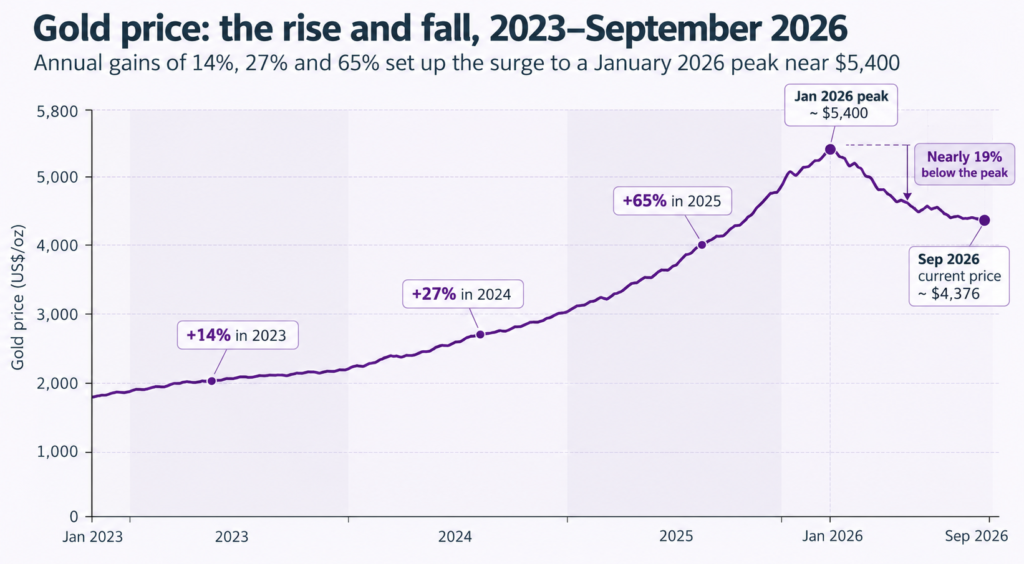
At the time of writing spot gold is around $4,376 an ounce, almost 19% below the record of roughly $5,400 reached at the end of January. Gold fell more than 2% on 4 September alone after surprisingly strong US employment figures pushed bond yields higher and increased expectations that the Federal Reserve could raise interest rates again.
For investors who watched gold rise and wondered whether they had missed their chance, the fall creates an obvious question: Is this a better time to buy gold?
Maybe. But a lower price isn’t, on its own, a reason to invest. A better question is what job could gold do in your portfolio?
That question has become more interesting because shares and bonds have increasingly moved together during periods of market stress. Gold offers something different.
Gold has fallen, but that doesn’t mean you should buy it
Gold rose 14% in 2023, 27% in 2024 and 65% in 2025. By February 2026, it had gained more than 170% since Russia’s invasion of Ukraine four years earlier. So even after falling nearly 20% from its peak, gold has already enjoyed an extraordinary run.
That matters because the argument shouldn’t be: Gold has fallen 20%, therefore it must be cheap. It should be: Gold has fallen, can this still do a job in my portfolio.
What actually moves the gold price?
A company can grow its profits and pay dividends. A bond pays interest. Cash earns interest. Whereas Gold doesn’t produce an income or dividends, so valuing Gold is very difficult.
Historically interest rates have been very important in valuing Gold. If government bonds offer a return of 5% while inflation is 2%. An investor can earn roughly 3% above inflation. So if you are buying Gold, you expect the price to rise more than this each year.
And we saw that relationship with interest rates very clearly on 4 September. Strong US employment data increased expectations of higher interest rates, Treasury yields rose and gold fell by more than 2%. Yet this doesn’t tell the whole story anymore.
Something changed after 2022
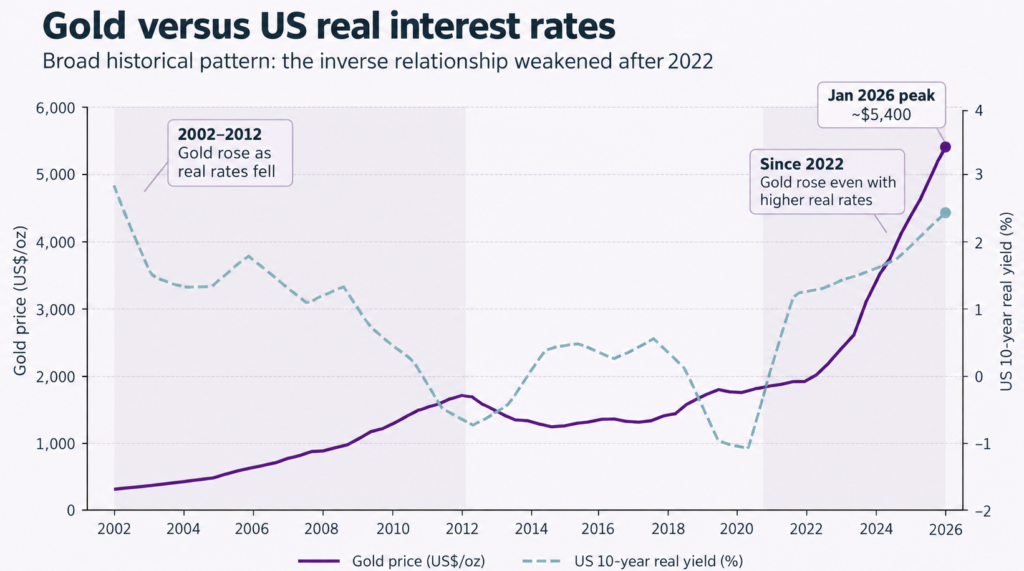
Historically, gold and real interest rates often moved in opposite directions. Gold tended to rise when real yields fell and struggle when real yields increased.
But the recent gold bull market has been different. Gold rose strongly even while real interest rates were rising and then remained relatively high.
Why? The world changed after Russia invaded Ukraine. Western governments froze Russian foreign-exchange reserves. That reminded central banks that reserves held in another country’s financial system can potentially become inaccessible.
Gold is different. Physical gold isn’t another government’s debt and doesn’t depend on a company paying what it owes. For some central banks, particularly emerging-market countries, that has increased its attraction as part of their reserves.
Official gold purchases averaged more than 1,000 tonnes a year during the previous three years, almost three times the average of the preceding decade.
Are central banks still buying?
They are, World Gold Council data show central banks bought an estimated 289 tonnes in the second quarter of 2026, up 62% from the same quarter in 2025. But first-half purchases of 345 tonnes were the lowest for a first half since 2022.
A World Gold Council survey published in June found that 89% of reserve managers expected global central-bank gold holdings to increase over the next 12 months, while 45% expected their own central bank to increase its holdings.
But there is another warning in the latest data. Gold-backed Exchange Traded Funds suffered 45 tonnes of outflows in the second quarter, partly as investors took profits and also considered inflation and interest-rate expectations.
Do you buy Gold when you are worried about inflation
One of the standard arguments for buying gold is protection against inflation. Research is much less convincing on that point.
The 1970s were the one clear period when gold provided strong protection against sustained high inflation. Between 1974 and 1982, gold produced a real annualised return of 13%, while US government bonds lost money after inflation.
But 2022 told a different story. Inflation surged, yet gold returned roughly 0%. It did better than US shares and government bonds, which fell 18% and 20%, but gold didn’t rise simply because inflation was high. Inflation that causes interest rates to rise can actually be bad for gold. So the relationship .between Gold and inflation is not clear.
The stronger argument for gold is diversification
For me, this is the most interesting part of the case. For many years investors could build a fairly simple portfolio:
Shares for growth. Bonds for income and protection.
When fears about economic growth caused shares to fall, government bonds would often rise. That relationship hasn’t worked as reliably since 2020 shares and bonds have increasingly fallen together during periods of market stress since the pandemic. See that chart below which shows how the correlation of bonds and equities has risen.
This has been due to supply shocks, higher inflation, larger government borrowing requirements and higher interest rates.
That doesn’t mean bonds have stopped being useful. But it does mean investors have a reason to consider assets whose returns come from different sources. Gold is certainly something to consider.
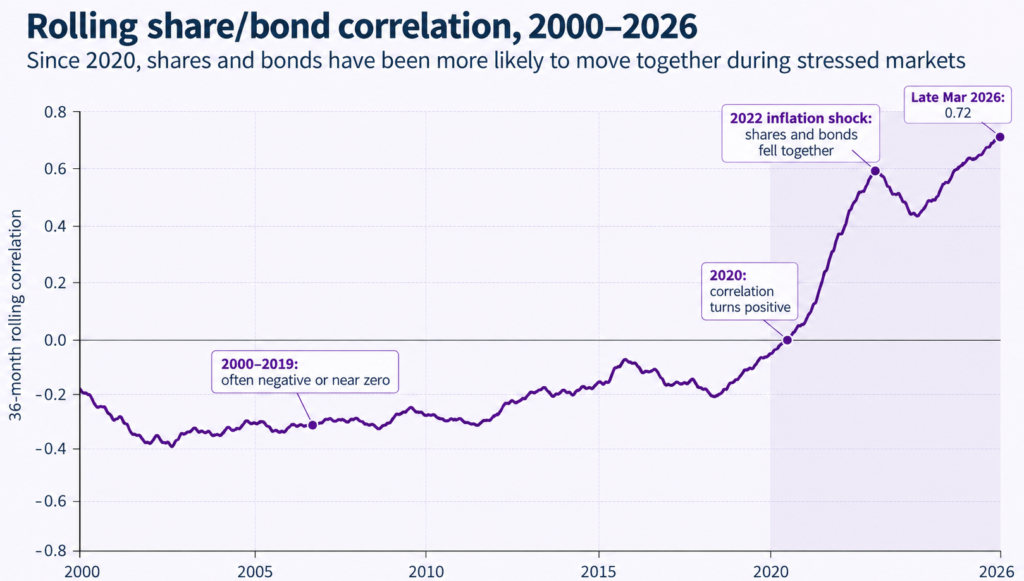
Why it matters: if shares and bonds both react badly to the same inflation or government-debt shock, a traditional 60% equities 40% bonds portfolio may provide less protection than an investor expected.
Where gold can help
There is an interesting report from J.P. Morgan, they looked at 12 major geopolitical events since Iraq’s invasion of Kuwait in 1990. Their analysis found that gold was the most resilient safe-haven asset around those events, gaining an average of around 4% in the following month. (JPMorgan)
A geopolitical crisis can simultaneously produce:
- falling equity markets;
- rising inflation expectations through higher oil prices;
- questions about government borrowing and currencies;
- demand for assets that aren’t somebody else’s liability.
Gold can potentially benefit from those conditions.
But there is a distinction worth making. Gold appears particularly useful against certain geopolitical, currency and fiscal shocks. Government bonds can still be much better protection against a conventional recession. J.P. Morgan found that US government bonds have historically performed better than gold during equity bear markets. (JPMorgan)
Gold shouldn’t therefore replace your bonds. But it can sit alongside them.
Gold still carries plenty of risk
Gold is often described as a safe haven, but that is not always the case. Over the last ten years gold’s realised volatility has been around twice that of US government bonds and as much as US equities.
The experience of 2026 proves the point. An investor buying near $5,400 in January has seen gold fall to around $4,376.
Gold also has no natural valuation level. A company can be assessed using profits, cash flow and dividends; a bond has an income stream and maturity value Gold has neither.
Its value is ultimately determined by what investors are prepared to pay for it.
So what job should gold do?
Gold is normally used as a smaller position in portfolios. An investor might, for example, allocate 5% to 10% of a portfolio to gold, funded by reducing the equity and bonds positions. UBS has recommended around 5% in a balanced portfolio as a long-term hedge against geopolitical risks. BlackRock has gone further in one portfolio study, replacing part of a traditional 60/40 allocation with gold: 60% global equities, 31% global bonds and 9% gold, aiming for similar overall risk but better protection during market falls.
How can a UK investor buy gold?
Physical coins and bars are one option. But Physical ownership has costs, though: dealing spreads, storage, security and insurance.
For many DIY investors, a physically backed gold ETC may be simpler. It can usually be held through the same investment platform as funds and shares. Check charges, how the gold is held and whether the ETC is available within your ISA or pension.
UK investors should also remember currency.
International gold is normally quoted in US dollars. The return you receive in sterling therefore depends on both the gold price and the pound-dollar exchange rate unless the investment is currency hedged.
Gold-mining shares are different again. They own businesses that mine gold, so energy costs, management decisions, debt and political risks can affect their returns. They shouldn’t be treated as a substitute for holding gold itself.
Should you buy gold after the fall?
I wouldn’t buy it simply because it is nearly 20% below January’s record.
This is really about the traditional relationship between shares and bonds has become less dependable. Geopolitical risks remain high. Governments are borrowing heavily, central banks continue to add gold to their reserves and questions about currencies and inflation haven’t disappeared.
Gold offers exposure to a different set of drivers.
But it is volatile, it doesn’t always protect against inflation and it isn’t a replacement for government bonds.
That leads to four better questions:
- What job would gold do in my portfolio?
- How much would I hold as a permanent allocation?
- What would I reduce to make room for it?
- Would I still be comfortable holding it if gold fell another 20%?
If you can answer those questions, the recent fall gives you a sensible reason to take another look. If you can’t, the fact that gold once traded at $5,400 isn’t a reason to buy it today.