The bond market takes the headlines
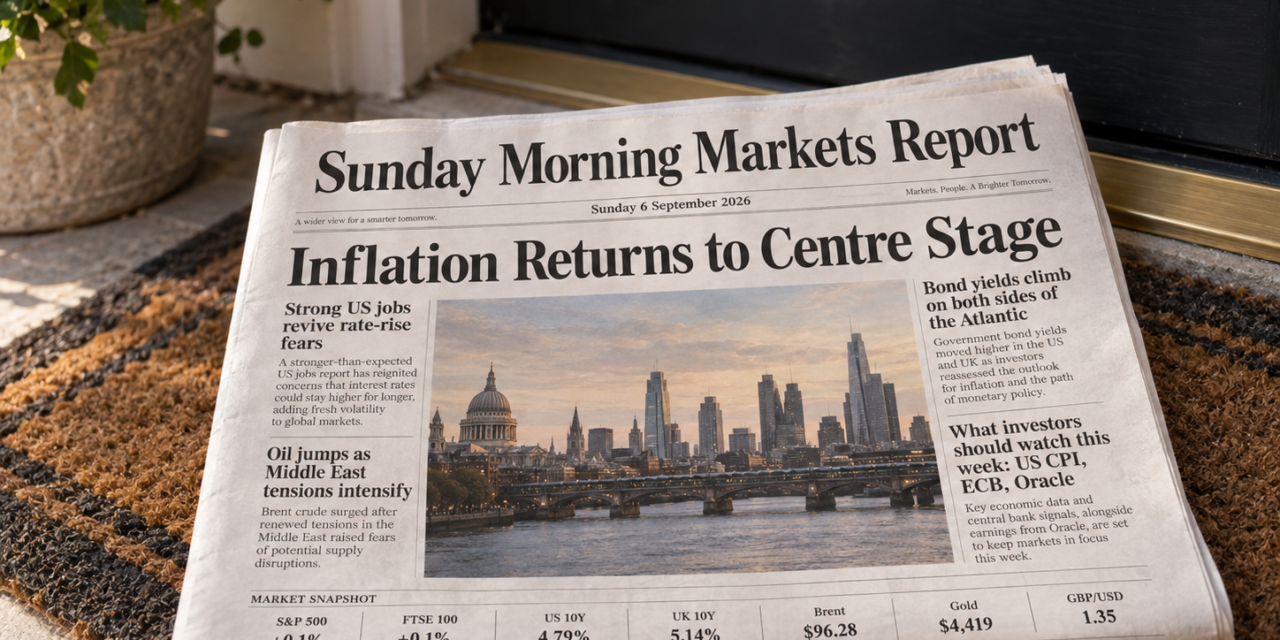
The headline equity indices barely moved over the week, but that hides a much more unsettled picture underneath. Bond yields rose sharply, Brent crude gained 7.6%, and Friday’s stronger-than-expected US jobs report pushed investors back towards expecting another Federal Reserve rate rise this month.
S&P 500
+0.1%
Last week
FTSE 100
+0.1%
Last week
US 10-year gilt
4.79%
Last week
Brent Crude
$96
Last week
The big picture
Strong jobs, expensive oil and rising bond yields put inflation back at centre stage
Markets entered September with three pressures arriving at once: a renewed rise in oil, a global government bond sell-off and a US labour market that proved much stronger than investors expected.
That combination matters because it weakens the case for central banks to ease policy. The S&P 500 still finished the week fractionally higher, but the calm at index level disguises a market increasingly sensitive to interest rates. Global money market funds attracted $46.1 billion in the week to 2 September as some investors moved towards cash.
For the coming week, one question dominates: will inflation confirm that another round of rate rises is needed, or give central banks room to wait?
Last week: Three things that mattered
1
US employment was far stronger than expected
What happened?
The US economy added 162,000 jobs in August, almost three times the consensus estimate of around 56,000. June and July were also revised higher by a combined 55,000 jobs, while unemployment held at 4.1%.
Why markets reacted
Only a month ago, investors were worried that the US labour market was weakening rapidly. Friday’s report challenged that view.
A strong jobs market means households are more likely to keep spending, which supports economic growth and corporate profits. But it also gives the Federal Reserve less reason to tolerate inflation above target.
The probability implied by futures markets of a September rate increase moved back towards 60% after the data. Treasury yields and the dollar rose; gold fell.
Why this matters
The argument has shifted. Investors are no longer asking whether the US economy is strong enough to avoid recession. They are asking whether it is too strong for inflation to fall quickly.
That makes this week’s inflation figures especially important.
2
The global bond sell-off reached Britain
Government borrowing costs rose across the developed world.
The US 10-year Treasury yield ended Friday near 4.79%, while Britain’s 10-year gilt yield was around 5.14%. Earlier in the week, UK yields reached their highest levels since the global financial crisis, while long-dated gilt yields climbed to levels last seen in the late 1990s.
Several forces are at work: persistent inflation, heavy government borrowing, rising defence spending and large amounts of corporate borrowing to finance AI infrastructure.
Bank of England Governor Andrew Bailey also pointed to ageing populations, weak productivity and higher government spending as longer-term pressures on sovereign debt markets.
For UK investors, this has immediate consequences. Higher gilt yields make bonds more attractive, but they also feed through into mortgage rates, company borrowing costs and government finances.
3
Oil surged as US-Iran tensions intensified
Brent crude finished Friday at $96.28 a barrel, up 7.6% over the week.
The move followed renewed US-Iran military action and continuing disruption to shipping through the Strait of Hormuz. Only a fraction of normal commercial traffic has resumed through one of the world’s most important energy routes.
Then, on Saturday, the US confirmed strikes against three Iranian oil tankers after Iranian forces attacked American naval vessels. That keeps the geopolitical risk very much alive as markets reopen.
Why does this matter? Oil above $95 makes the inflation problem harder. It raises transport and production costs and puts pressure on household energy bills. If Brent moves sustainably above $100, central banks may be forced to keep rates higher for longer.
This week: What investors should watch
1. US inflation could decide September’s Fed meeting
Producer prices arrive on Thursday, followed by the much more important Consumer Price Index on Friday.
Economists expect headline CPI to rise around 0.4% during August, with core inflation up about 0.2%.
A softer reading would weaken the argument for an immediate rate rise and could push Treasury yields lower.
A stronger number, following Friday’s employment report and the latest jump in oil, would make a September increase much harder for the Fed to avoid.
For equity investors, this is probably the week’s single most important data point.
2. The ECB looks set to raise rates
The European Central Bank meets on Thursday 10 September.
Markets are pricing almost a full 25 basis-point increase, reflecting persistent inflation and renewed energy pressure. Reuters polling also suggests economists expect another increase this week, although views differ on whether that completes the cycle.
The rate rise itself may therefore matter less than what ECB President Christine Lagarde says afterwards.
If the ECB leaves the door open to more tightening, European bond yields and the euro could rise. A suggestion that this is the final move would probably be better received by rate-sensitive shares.
3. Oracle provides another AI spending test
With the main earnings season largely complete, Oracle is among the week’s more significant corporate reports.
Investors will focus on cloud infrastructure demand and spending related to artificial intelligence. The broader AI story remains powerful, but markets are increasingly separating companies generating revenue from AI from those simply spending heavily on it.
A strong cloud outlook could help technology shares. Disappointing guidance would add to concerns that valuations have run ahead of earnings.
4. Japan’s bond market deserves attention
Japan’s long-term government bond yields have risen to levels not seen for decades, with parts of the curve moving above 3%.
That may sound distant from a UK portfolio, but it matters because Japanese investors own enormous quantities of overseas bonds.
If domestic Japanese yields become more attractive, pension funds and insurers have less reason to hold US Treasuries or European government bonds. Even a gradual shift in capital could add upward pressure to global yields.
Why the bond market is sending a different message from the stock market
Equity markets remain close to record highs, yet government bond yields have risen sharply.
That apparent contradiction tells us something useful.
Shares are pricing strong corporate profits, resilient economic growth and continued enthusiasm around artificial intelligence. Bond markets are focused on something else: inflation, borrowing and the amount of debt governments need investors to absorb.
Both can be right for a while.
A strong economy can support earnings while simultaneously keeping inflation high enough to push yields upwards. The difficulty comes when those higher yields start to affect company valuations.
At a US Treasury yield near 4.8% and a UK gilt yield above 5%, investors can earn a meaningful return from government bonds without taking equity risk. That raises the hurdle companies must clear to justify expensive share prices.
It also restores balance to diversified portfolios.
For much of the decade after the financial crisis, bonds offered very little income. Today they offer both income and the potential to provide some stability if economic growth eventually weakens.
The lesson isn’t that bonds are now better than shares. It is that investors no longer need one asset class to do everything.
Five Things I'll Be Watching
1. US CPI – Friday’s figure could settle the argument over a September Fed rate rise.
2. Brent crude – A sustained move above $100 would worsen the global inflation outlook.
3. 10-year gilt yield – Britain above 5% keeps pressure on mortgages, government finances and rate-sensitive shares.
4. ECB decision – The market expects a rise; the message about what comes next matters more.
5. Japan’s bond market – Higher domestic yields could gradually change global capital flows.
Final thought
The first week of September produced very little movement in the main equity indices, yet plenty changed underneath.
US employment looked stronger, oil jumped and government borrowing costs rose across major markets.
What it does mean is that bonds, inflation and interest rates deserve at least as much attention as the latest stock-market record.
Markets react to every new number. Long-term investors don’t need to. A well-diversified portfolio should be built to cope with several economic outcomes, not depend on correctly predicting next Friday’s inflation report.