Oil back over $100 as stock markets fall
It was a difficult week despite Friday’s rebound. The S&P 500 ended around 0.6% lower, the FTSE 100 suffered its largest weekly decline since late July, and MSCI World fell around 1.7%. Brent crude was the standout mover, gaining more than 8% as disruption in the Gulf pushed oil firmly back above $100.
S&P 500
-0.6%
Last week
FTSE 100
-1.7%
Last week
US 10-year gilt
4.93%
Last week
Brent Crude
$104.61
Last week
The big picture
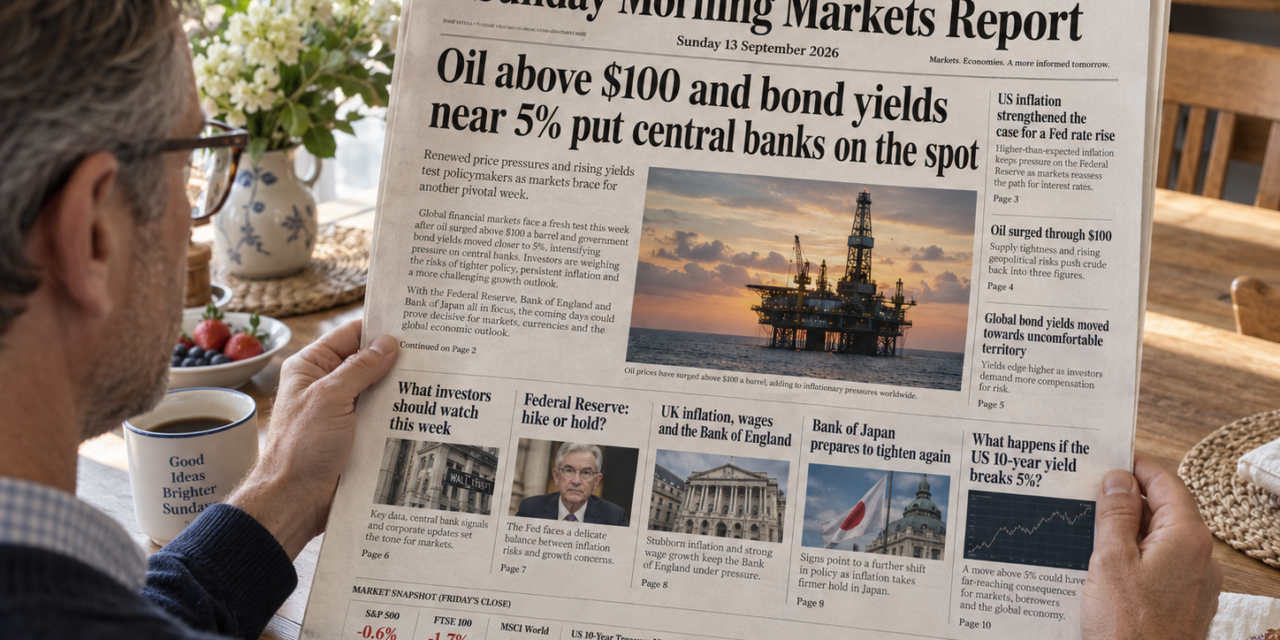
Oil above $100 and bond yields near 5% put central banks on the spot
For much of this year, investors have been able to rely on two supports: strong company profits and the hope that inflation would gradually move lower.
Last week challenged the second part of that argument.
US inflation accelerated in August, Brent crude surged above $100 a barrel, and government bond yields moved sharply higher. The US 10-year Treasury briefly came within a fraction of 5%, while UK borrowing costs climbed to levels not seen since before the financial crisis.
Markets now face an unusually important week. The Federal Reserve, Bank of England and Bank of Japan all meet, while UK inflation and wage figures arrive just as energy prices are adding fresh pressure.
The question has changed. Investors are no longer wondering when interest rates might fall. They are asking how much further they may have to rise.
Last week: Three things that mattered
1
US inflation strengthened the case for a Fed rate rise
August’s US Consumer Price Index rose 0.4% during the month, taking annual inflation to 3.4%. Core prices, which exclude food and energy, increased 0.3%, slightly more than economists expected. Producer prices had already surprised on the upside a day earlier.
Markets reacted quickly. By Friday, futures were pricing roughly an 85% probability of a quarter-point Federal Reserve rate increase this week, compared with a much less certain picture only days earlier.
The significance extends beyond one Fed meeting. Inflation has remained above the 2% target for years, while employment and consumer spending remain reasonably firm. The Fed therefore has room to tighten without immediately threatening recession.
For equity investors, that means the interest-rate hurdle remains high. Expensive growth companies can continue rising if profits justify their valuations, but the margin for disappointment is shrinking.
2
Oil surged through $100
Brent crude ended Friday at $104.61, more than 8% higher over the week and briefly touching almost $110. Attacks on Middle Eastern shipping routes and infrastructure intensified fears that supply through the Strait of Hormuz and Red Sea could remain disrupted.
Oil matters because an energy shock behaves rather like a tax on consumers and businesses. Households spend more on fuel and heating; companies face higher transport and production costs.
It also makes the job of central banks harder.
The problem isn’t merely that current inflation rises. Policymakers worry that businesses and workers begin expecting higher inflation and adjust prices and wages accordingly.
A sustained Brent price above $100 would therefore make rapid interest-rate cuts increasingly unlikely across the US, UK and Europe.
3
Global bond yields moved towards uncomfortable territory
The US 10-year Treasury yield briefly touched 4.99% before ending around 4.93%. Britain’s 10-year gilt climbed above 5.3%, while 30-year gilt yields approached 6%, their highest levels since 1998.
Rising oil explains part of the move, but investors are also worried about government borrowing and the huge amount of debt being issued.
That matters for portfolios because government bonds establish the return investors can receive without taking company risk. If a US Treasury yields close to 5%, a share trading at a very demanding valuation must offer a convincing reason to own it instead.
Higher yields also increase mortgage rates, company financing costs and the government’s own interest bill.
For UK investors, the bond market may now matter every bit as much as the stock market.
This week: What investors should watch
1. Federal Reserve: hike or hold?
The Fed meets on 15–16 September, with its decision due on Wednesday evening UK time. It will also publish updated economic projections.
Markets now strongly favour a 0.25 percentage-point increase, which would take the policy range to 3.75%-4.00%.
The decision itself may not be the main market mover. Investors will concentrate on Chair Kevin Warsh’s press conference and the Fed’s forecasts.
If policymakers suggest one increase is sufficient, bonds and shares could respond positively. If they indicate the start of a longer tightening cycle, Treasury yields could move decisively above 5%, putting pressure on equity valuations.
2. UK inflation, wages and the Bank of England
Britain has a packed three days.
Labour-market figures arrive on Tuesday, August inflation on Wednesday, and the Bank of England announces its rate decision on Thursday.
July CPI was already 2.9%, while energy prices have since moved sharply higher. At the same time, UK GDP surprised positively, growing 0.4% in July.
Markets don’t currently expect the Bank to raise its 3.75% rate this week, but a strong wage number followed by another inflation increase would make a later hike much harder to rule out.
Watch gilt yields and sterling as closely as the Bank Rate announcement.
3. Bank of Japan prepares to tighten again
The Bank of Japan is widely expected to raise rates by 0.25 percentage points to 1.25%, its second increase in three months.
Japan matters well beyond Tokyo.
For decades, very low Japanese interest rates encouraged domestic investors to buy foreign bonds and financed so-called carry trades, where investors borrowed cheaply in yen to purchase higher-yielding assets elsewhere.
Higher Japanese rates make those trades less attractive. Japanese pension funds and insurers may also find domestic bonds increasingly competitive with US and European debt.
The effect will probably be gradual, but another source of cheap global money is disappearing.
4. Oil remains the unscheduled event
There is no economic calendar entry for geopolitical escalation, yet oil may have more influence on markets than any scheduled release.
Brent ended the week above $104 even after Friday’s fall. The International Energy Agency has warned that disrupted Gulf flows have widened the expected global supply shortfall.
Progress towards reopening shipping routes could push oil lower and provide relief to bonds.
Another disruption could send crude back towards last week’s $110 high and quickly alter interest-rate expectations again.
What happens if the US 10-year yield breaks 5%?
There is nothing magical about 5%, but round numbers matter because they often change investor behaviour.
At a 2% Treasury yield, an investor seeking a decent long-term return has little choice but to accept more risk. At 5%, government bonds become much harder to ignore. It creates competition for equities.
It is especially relevant to companies valued on profits expected many years into the future. The higher the rate investors use to discount those future profits back into today’s money, the lower their present value becomes.
A 5% Treasury yield also affects the real economy. Mortgages, corporate loans and government borrowing costs tend to rise with it. Eventually that can reduce investment and consumption.
None of this says shares must fall if Treasury yields move above 5%. Strong profit growth can outweigh higher discount rates, and US corporate earnings have remained healthy. But the investment choice has changed.
For UK investors building balanced portfolios, government bonds once again offer meaningful income. Equities remain the main long-term growth engine, but investors no longer need shares to provide every part of their return.
That strengthens the case for diversification rather than weakening it.
Five Things I'll Be Watching
- Federal Reserve – Markets expect a rate rise; the bigger question is whether the Fed signals more are coming.
- US 10-year Treasury – A sustained move above 5% would test equity valuations.
- UK inflation – Higher energy costs could push CPI further away from the Bank of England’s target.
- Brent crude – Oil above $100 has become one of the main drivers of global interest-rate expectations.
- Bank of Japan – Another rate increase could affect bond yields and capital flows far beyond Japan.
Final thought
ast week’s market moves provide a useful reminder that economic conditions can change quickly.
A month ago investors were debating whether weakening employment might eventually allow interest rates to fall. Today, stronger growth, stubborn inflation and $100 oil have brought rate increases back into the conversation.
That doesn’t mean a diversified long-term investor needs to make a dramatic portfolio change.
It does mean today’s bond yields deserve attention. Shares still offer long-term growth, while bonds now offer income at levels investors haven’t enjoyed for many years.