Clearly Investments | Investor risk tool
How much investment risk can you take?
Risk is not just about how brave you feel. This assessment looks separately at your financial capacity for risk and how composed you may remain when markets fall.
Your answers are assessed in your browser. They are not saved or sent to Clearly Investments.
Your assessment
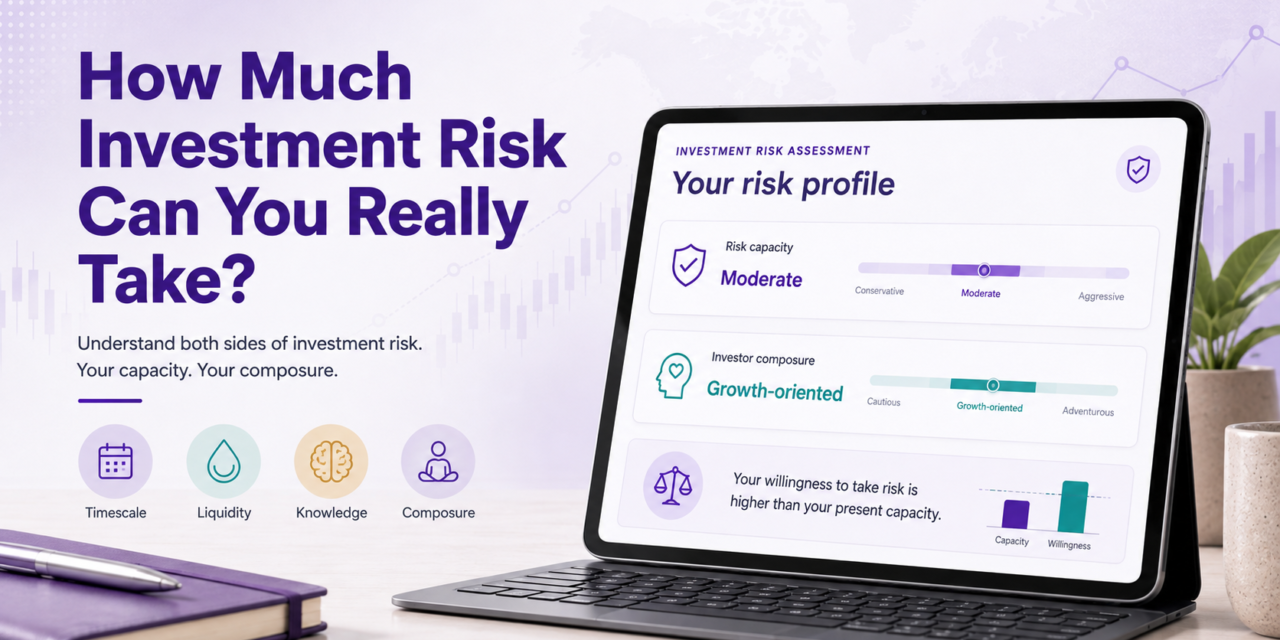
Your two risk results
These results are shown separately because willingness to take risk cannot make up for a short timescale, insufficient liquidity or an inability to absorb losses.
The level of investment risk your circumstances appear able to support.
How comfortable you appear to be with market uncertainty and losses.
Your familiarity with investments. This is not a measure of financial capacity for loss.
—
—
What shaped your result
How the scorecard works
| Score | Risk capacity | Investor composure |
|---|---|---|
| 5–8 | Very limited | Very cautious |
| 9–12 | Limited | Cautious |
| 13–17 | Moderate | Balanced |
| 18–21 | Strong | Growth-oriented |
| 22–25 | Very strong | Adventurous |
Capacity constraints can reduce the capacity result even where the total answers would otherwise place it in a higher range. A low knowledge score adds an educational caution; it should not be treated as permission to use complex investments.
How to think about the results from the risk questionnaire
Risk questionnaires often ask a version of the same question: How comfortable are you taking investment risk? That matters—but it is only part of the answer.
Someone may feel perfectly relaxed about stock-market falls yet need the money in two years. Another person may have a secure income, plenty of accessible savings and a 20-year investment horizon, but still be deeply uncomfortable when markets fall. These investors should not necessarily reach the same conclusion.
That is why the Clearly Investments Risk Assessment considers two separate dimensions:
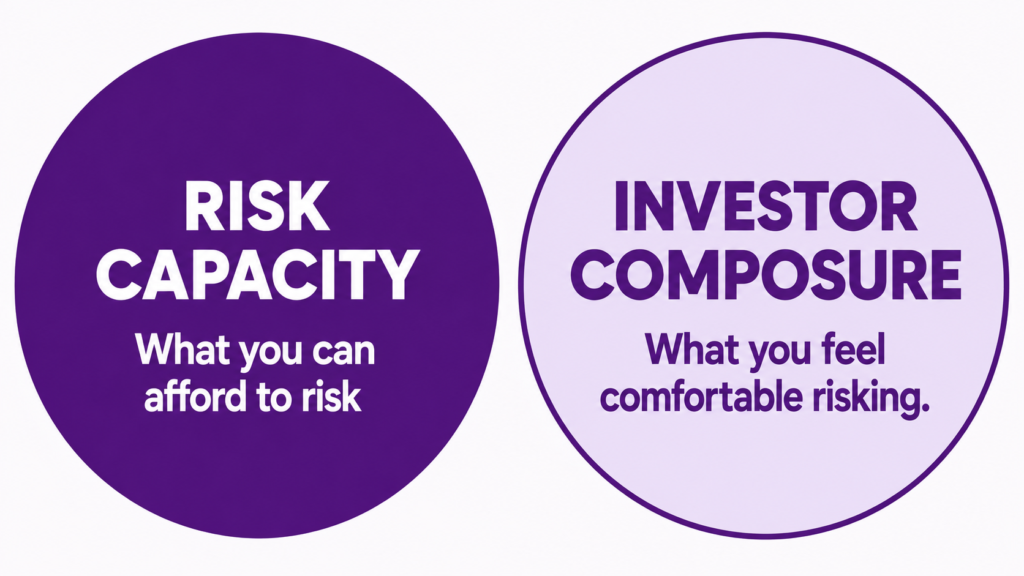
- Risk capacity: how much investment risk your financial circumstances allow you to take.
- Investor composure: how likely you are to remain calm and stick to your plan when markets become unsettled.
The distinction is also reflected in the FCA’s suitability framework for regulated advice. It considers an investor’s risk tolerance, financial ability to bear losses, and knowledge and experience as separate factors. The Clearly Investments tool is educational rather than a regulated suitability assessment, but the same separation provides a useful way to think about risk.
Risk is personal—but it is not just about personality
Investment risk is sometimes presented as a character trait: cautious people hold safer investments, while confident people take more risk. Real life is more complicated.
The risk you can sensibly take depends on what the money is for, when you will need it, how much accessible cash you have elsewhere and what would happen if the investment suffered a substantial loss. Your willingness to accept fluctuating values matters too, because even a financially affordable fall can lead to a damaging decision if it causes you to sell at the wrong time.
A useful assessment therefore asks two different questions:
- Can I afford to take this risk?
- Can I live with this risk?
The answers may be very different.
Investor composure: how might you respond when markets fall?
Investor composure is your ability to cope with uncertainty, falling portfolio values and unsettling headlines without abandoning a sensible long-term plan.
Imagine that a £100,000 portfolio falls to £80,000. Would you sell everything, reduce the investment, wait nervously, remain invested or consider adding more? There is no “correct” response to select in a questionnaire. The useful answer is the honest one.
It is easy to feel adventurous when markets are rising. The real test comes when the loss is measured in pounds rather than percentages and the news is full of convincing reasons why prices could fall further. Previous behaviour during difficult markets may therefore tell you more than how you feel today. New investors, who have not yet experienced a major decline, should be particularly careful not to overestimate their composure.
S&P 500 intra-year declines vs. calendar-year returns
Market falls are not unusual interruptions to investing; they are part of the experience.
J.P. Morgan have produced data covering 1980 to 2025 this tells much the same story. The S&P 500’s average fall within a calendar year was 14.2%, but the index nevertheless finished with a positive return in 35 of the 46 years.
In other words, investors regularly experience a meaningful fall at some point during a year—even when the year eventually proves rewarding. A temporary decline and a permanent loss are not the same thing. Selling during the decline can turn the former into the latter.
This does not mean every fall will recover quickly or that investors should ignore a portfolio which no longer meets their needs. It means that a portfolio containing shares should be selected in the expectation that sizeable falls will occur. If an ordinary 10%–15% setback is likely to make you sell, a very equity-heavy portfolio may be difficult to hold through a full market cycle.
Risk capacity: would a loss damage your financial plans?
Risk capacity is not about how a loss would make you feel. It is about what that loss would do.
If a 20% permanent loss would prevent you from meeting essential spending, buying a home or funding an imminent retirement, your capacity for risk is limited. If the same fall would merely delay a discretionary goal while your essential plans remained secure, your capacity may be stronger.
The amount invested matters, but so does your reliance on it. A £20,000 loss may be manageable for one household and life-changing for another. Property and pensions also contribute to wealth, but they may not help with a bill that must be paid next month. That is why capacity should consider accessible assets, regular income, financial commitments and the purpose of this particular investment—not just total net worth.
Why timescale and liquidity matter
Time does not remove investment risk, but it gives an investor more opportunity to ride through a downturn and participate in a recovery. Money needed shortly may have to be withdrawn before that recovery arrives.
Historical S&P 500 figures through the end of 2025 illustrate how outcomes have varied with the holding period:
| Holding period | Positive historical periods | Negative historical periods |
|---|---|---|
| 1 year | 74% | 26% |
| 3 years | 84% | 16% |
| 5 years | 88% | 12% |
| 10 years | 94% | 6% |
These figures describe what happened in one market over a particular historical period; they are not the odds for the next five or ten years. They nevertheless show why investing money for one year is very different from investing it for a decade.
This is why liquidity matters. Accessible cash can cover emergencies, planned spending and near-term withdrawals without forcing the sale of investments at an unfavourable time. There is no single cash amount that suits everyone, but money earmarked for imminent commitments should not be treated as long-term investment capital.
The role of knowledge and experience
Knowledge, experience and understanding—shortened to KEU within the tool—help determine whether you understand the risks you are taking.
This includes understanding that shares and bonds can both fall, that diversification reduces reliance on a single investment but cannot prevent every loss, and that higher expected returns normally come with greater uncertainty. Experience of living through an actual bear market can be particularly valuable.
A high knowledge score does not increase your financial ability to absorb a loss. Equally, limited experience does not automatically mean that all investment risk is unsuitable. It may instead suggest beginning with straightforward, diversified investments and learning more before considering complex or highly concentrated holdings.
Why willingness and capacity can point in different directions
Your composure and capacity scores should be shown separately rather than averaged into one number. Averaging can disguise an important conflict.
| Assessment result | What it may mean |
| Composure is higher than capacity | You may feel comfortable taking substantial risk, but your timescale, liquidity or reliance on the money limits what you can afford to take. |
| Capacity is higher than composure | Your finances may withstand market falls, but a more volatile portfolio could be difficult for you to hold. |
| Both are limited | Protecting near-term plans and maintaining liquidity may be more important than seeking higher returns. |
| Both are strong | You may be able and willing to accept more fluctuation, but diversification and a long-term plan still matter. |
Capacity should normally act as the upper constraint. Confidence cannot compensate for needing the money soon or being unable to absorb a loss.
What should you do when the scores conflict?
If composure exceeds capacity, do not simply take more risk because you believe you can handle the volatility. Revisit the timescale, the amount held in accessible savings and the consequences of a loss.
If capacity exceeds composure, taking the maximum risk your finances could withstand may be counterproductive. A somewhat less volatile portfolio that you can maintain through difficult periods may produce a better real-life outcome than an aggressive portfolio you abandon during the next downturn.
If the return required to reach your goal appears to demand more risk than you can afford or tolerate, the answer is not automatically to increase risk. Other choices include saving more, extending the timescale, changing the target or seeking regulated financial advice.
Risk changes as life changes
A risk assessment is a snapshot, not a permanent label. It should be revisited when the purpose of the money changes, a major withdrawal approaches, income becomes less secure, retirement begins or family commitments alter.
Composure can change too. Experiencing a significant market fall may reveal that your true tolerance is different from the answer you gave during calmer conditions. The aim is not to achieve the highest score. It is to choose a level of risk that your finances can support and that you can maintain when markets inevitably become uncomfortable.
Use the result as a starting point
The Clearly Investments Risk Assessment is designed to help you think separately about risk capacity, investor composure, timescale, liquidity and investment knowledge. It provides an educational indication, not a personal recommendation, psychometric diagnosis or regulated suitability assessment.
No questionnaire can capture every feature of your circumstances. Use the result as a starting point for further research and reflection. If you are unsure whether an investment or portfolio is suitable for you, consider speaking to an FCA-authorised financial adviser.
The value of investments can fall as well as rise, and you may get back less than you invest. Past performance is not a reliable guide to future returns.