Oil Surges, AI Shares Falter and Britain's Budget Takes Centre Stage
The figures conceal a much more unsettled week than the modest US equity decline suggests. The Nasdaq fell 0.7%, while smaller US companies performed better, with the Russell 2000 gaining 2%. In London, the FTSE 100 ended a two-week winning run.
Oil provided the week’s largest move, climbing approximately 7% to its highest level in more than five months. At the same time, gold slipped below $4,000 an ounce and government bond yields fell from their earlier highs as investors sought safer assets.
S&P 500
-0.5%
Last week
FTSE 100
-1.8%
Last week
US 10-year gilt
4.99%
Last week
Brent Crude
$177.38
Last week
The big picture
The cost of growth is becoming the market’s biggest concern
Two developments dominated last week: another sharp increase in oil prices and growing concern about the amount technology companies are spending on artificial intelligence.
Neither is particularly welcome for investors.
Higher energy costs threaten inflation and corporate profit margins, while the AI investment boom increasingly depends on raising enormous amounts of capital. With long-term borrowing costs still high, investors are becoming more demanding about when those investments will produce returns.
For British investors, there is a third issue. Wednesday’s Autumn Budget comes at a time when inflation has risen again, household spending is weakening and gilt yields remain above 5%.
The coming week could be one of the most significant of the year, with the Budget, Federal Reserve decision and results from Microsoft, Alphabet and Amazon all competing for attention.
Last week: Three things that mattered
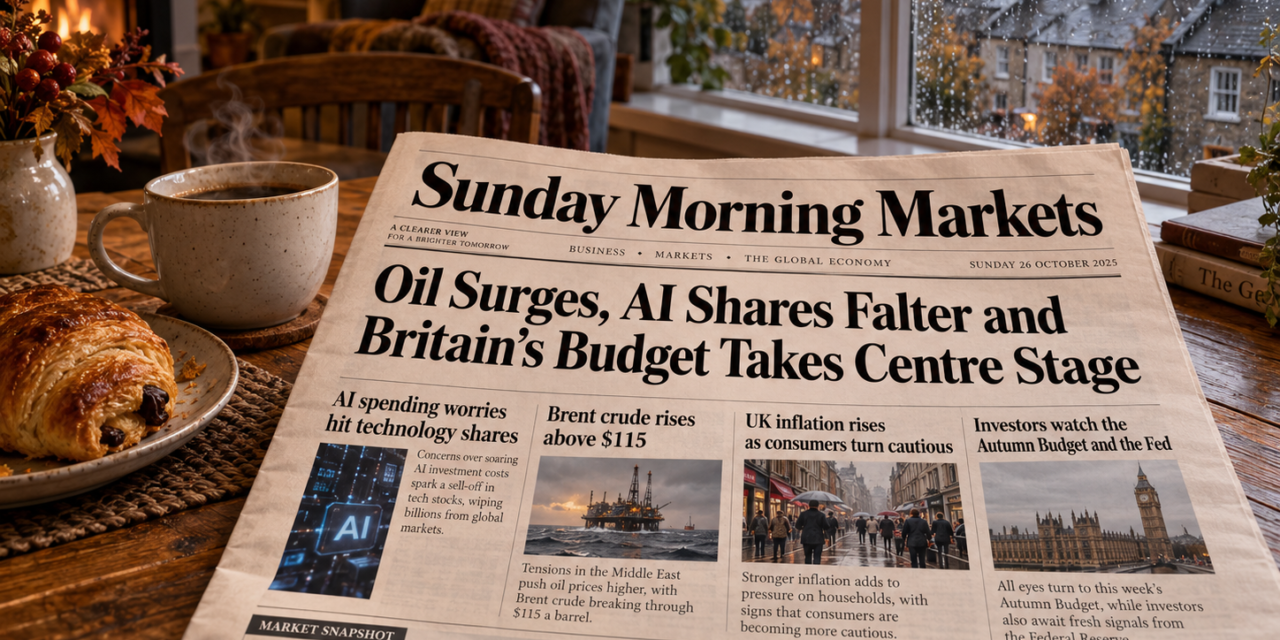
AI spending worries triggered another technology sell-off
What happened? Thursday brought the sharpest market reaction of the week. The Nasdaq fell 2.6%, while the Philadelphia Semiconductor Index lost 6.7%.
Meta was at the centre of the sell-off. Despite reporting strong revenues, the company increased the lower end of its 2026 capital expenditure forecast, putting expected spending at $135–145 billion.
It also outlined plans for a new class of shares that could help finance future AI investment. Meta’s shares fell more than 7%, while Lam Research and several other semiconductor companies suffered substantial declines.
Why markets reacted: Investors aren’t questioning whether AI demand exists. They’re questioning the financial returns from building the infrastructure needed to satisfy it.
Higher capital expenditure reduces free cash flow, the money left after operating costs and investment in the business. Debt financing also becomes more expensive when interest rates are high.
Why this matters: The AI boom is moving into a more demanding stage. Strong revenue growth may no longer be enough if borrowing, investment costs and shareholder dilution increase even faster.
Oil climbed above $115 as Middle East tensions intensified
What happened? Brent crude ended Friday above $117 a barrel, following attacks affecting energy infrastructure in Saudi Arabia and continued concerns about Middle Eastern oil supplies.
The price increase was large enough to lift the S&P 500 energy sector to a record high, even while the wider American market declined.
Why markets reacted: Oil prices influence inflation far beyond the petrol pump.
Higher fuel and transport costs affect food distribution, manufacturing and company margins. Some businesses can pass those costs to customers; others have to absorb them.
Why this matters: At current levels, oil is making it harder for central banks to bring inflation back towards their targets.
A sustained increase also acts as a drag on household spending. Money spent on energy isn’t available for other goods and services.
UK inflation rose as consumers became more cautious
What happened?: The latest ONS figures showed UK consumer-price inflation rising to 3.5% in September. That strengthened expectations that the Bank of England will increase Bank Rate at its November meeting.
There was less encouraging news from retailers. September retail sales volumes fell 0.4%, reversing part of August’s increase.
Consumer confidence also weakened sharply, while the FTSE 100 finished the week down around 1.8%.
Why markets reacted: Britain faces an uncomfortable combination of higher prices and weakening consumption.
The Bank of England wants inflation lower, but further interest-rate increases would put additional pressure on households and businesses.
Why this matters: For investors, the outlook for domestic UK companies depends increasingly on whether inflation falls before consumer spending deteriorates further.
The Budget now takes on even greater significance.
This week: What investors should watch
1. Wednesday: Britain’s Autumn Budget
Chancellor John Healey delivers his first Autumn Budget on 28 October.
The central challenge is familiar: how to maintain confidence in public finances while supporting an economy facing high inflation and weakening household demand.
Markets will scrutinise the size of the government’s borrowing plans, tax changes and forecasts for public spending.
Reports suggest banks could face higher taxation, while measures to contain household energy bills are also under consideration.
What could surprise investors? A credible plan to control borrowing could bring gilt yields lower, supporting sterling and UK assets sensitive to interest rates.
Unexpected tax increases or additional borrowing could produce a less favourable response.
The important market to watch may not be the FTSE 100, but UK government bonds. Higher gilt yields ultimately increase financing costs for households, businesses and government.
2. Wednesday: Federal Reserve interest-rate decision
The Federal Reserve announces its decision on 28 October at 6pm UK time, after Britain’s clocks have moved back to GMT.
Markets expect the Fed to leave its policy rate unchanged following September’s increase.
But inflation remains above target, while US economic growth is showing signs of slowing.
Federal Reserve Chair Kevin Warsh’s comments will therefore matter more than the decision itself.
What could surprise investors? A stronger indication that another rate rise is coming in December could push Treasury yields and the dollar higher.
A more cautious Fed, concerned about employment and growth, could provide relief to bonds and technology shares.
Thursday’s US GDP and PCE inflation releases will offer another test of that interpretation.
3. Wednesday and Thursday: The biggest test for AI earnings
Microsoft and Alphabet report on Wednesday, followed by Amazon on Thursday.
This is particularly significant after Meta’s disappointing share-price reaction.
Investors will examine cloud-computing revenue, profit margins, free cash flow and, above all, planned AI expenditure.
Microsoft’s Azure platform and Amazon Web Services provide a direct indication of how much customers are spending on cloud infrastructure. Alphabet’s results offer another perspective on AI adoption and advertising revenue.
What could surprise investors? Strong cloud growth accompanied by controlled capital spending would reassure investors.
Further announcements of enormous expenditure without convincing evidence of financial returns could put technology shares under renewed pressure.
For global index investors, these results matter because a handful of technology companies represent a significant proportion of US equity market value.
4. Thursday and Friday: ECB, Bank of Japan and US inflation
The European Central Bank decides rates on Thursday, followed by the Bank of Japan on Friday.
Both are expected to leave rates unchanged, although investors will be listening carefully for signals about future policy.
Thursday also brings the first estimate of US third-quarter GDP and September PCE inflation, the Federal Reserve’s preferred inflation measure.
The combination matters more than any one release.
Strong economic growth with persistent inflation would reinforce the case for higher interest rates.
Weak growth accompanied by easing inflation might help government bonds. Weak growth with rising inflation would be the more difficult outcome for both shares and bonds.
Investment Insight
AI investing: why cash flow matters more than revenue growth
Last week’s technology sell-off provides a useful lesson for long-term investors.
A company can report strong revenue growth and still disappoint shareholders.
Why? Because investors ultimately own a claim on future profits and cash generated by the business, rather than its sales.
Consider two companies investing £10 billion in AI infrastructure.
The first finances the expenditure from existing profits and has customers committed to using its services. The second borrows heavily, hoping sufficient demand emerges over the next five years.
Both may benefit from the same technological opportunity. Their financial risks are very different.
This becomes particularly important when government bond yields are around 5%.
Higher borrowing costs reduce the returns companies can generate from capital-intensive investments. They also increase the return investors demand before taking equity risk.
Three measures deserve attention: free cash flow, debt and return on invested capital.
Free cash flow shows the money remaining after operating expenses and capital expenditure. Debt indicates the company’s financial obligations. Return on invested capital measures how efficiently management uses the money committed to the business.
For UK investors holding global index funds, the lesson isn’t to abandon technology shares.
It is to recognise that technological success and investment success aren’t necessarily the same thing.
Diversification helps protect against paying too much for even a successful business.
Five Things I'll Be Watching
-
UK Autumn Budget: Wednesday’s decisions on taxes, spending and borrowing could move gilt yields and sterling.
-
Federal Reserve: Markets expect unchanged rates, but comments about December could alter global borrowing costs.
-
Microsoft, Alphabet and Amazon: Investors want evidence that extraordinary AI spending is producing worthwhile financial returns.
-
Brent crude: Oil above $115 threatens to keep inflation elevated and squeeze company profit margins.
-
UK gilt yields: With the 10-year yield around 5.37%, the bond market remains a major influence on Britain’s economic outlook.
Final Thought
Last week illustrated how quickly investor expectations can change.
Technology shares suffered despite continued AI growth, oil producers benefited from higher energy prices, and UK markets weakened as inflation and household spending moved in opposite directions.
Next week brings several events capable of moving markets sharply.
But long-term investors don’t need to predict the Budget, the Federal Reserve or Microsoft’s earnings.
A well-diversified portfolio should be designed to cope with different outcomes rather than depend on any one forecast being correct.