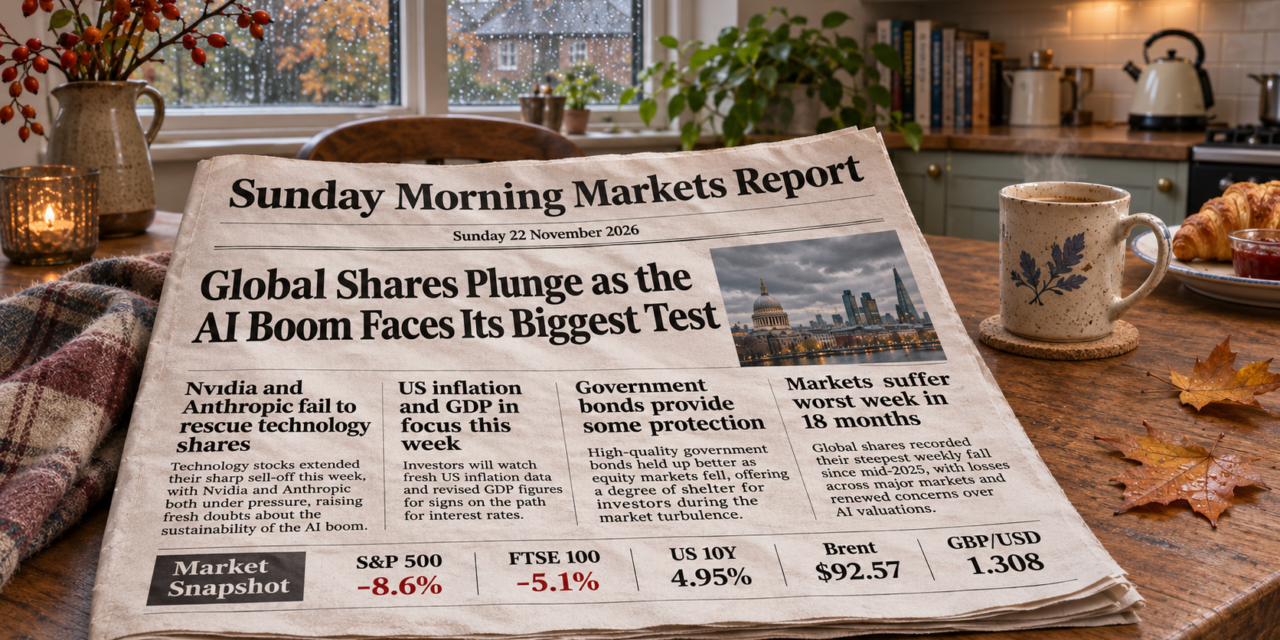
Global Shares Plunge as the AI Boom Faces Its Biggest Test
It was the worst week for American shares in more than 18 months. The S&P 500 fell 8.6%, while the Nasdaq lost 10%, its largest weekly decline since March 2020.
The sell-off spread worldwide. The FTSE 100 lost 5.1%, Germany’s DAX fell 7.3%, and Japan’s Nikkei declined 7.7%.
The S&P 500 and Dow Jones have now entered correction territory, meaning they have fallen more than 10% from their recent peaks.
S&P 500
-8.6%
Last week
FTSE 100
-5.1%
Last week
US 10-year gilt
4.95%
Last week
Brent Crude
$92.57
Last week
The big picture
Strong earnings are no longer enough
Last week was supposed to provide reassurance about artificial intelligence.
Nvidia delivered exceptional quarterly results, while Anthropic completed the largest stock market flotation in history.
Instead, technology shares suffered another sharp sell-off.
The problem isn’t a lack of demand for AI. Nvidia’s revenues more than doubled over the past year, demonstrating that businesses continue spending heavily on computing infrastructure.
Investors are increasingly questioning whether that expenditure can generate sufficient returns to justify today’s share prices.
The Federal Reserve has made the situation more difficult. Inflation remains above target, and markets now expect another interest-rate increase in December.
Investors are reassessing how much they should pay for future growth when borrowing costs remain high.
Last week: Three things that mattered
Nvidia and Anthropic failed to rescue technology shares
What happened? Nvidia reported quarterly revenue of $115.8 billion, an increase of 103% from a year earlier and comfortably ahead of expectations.
Data-centre revenue reached $107.6 billion, demonstrating continuing demand for AI computing.
Yet Nvidia shares fell approximately 23% over the week, including a 13.8% decline on Friday.
The company is also dealing with a leadership transition following Jensen Huang’s resignation, alongside questions concerning corporate governance and accounting.
Anthropic’s flotation offered another test of confidence.
The company raised approximately $81 billion in the largest IPO on record. Shares initially surged, but enthusiasm faded quickly, with the price falling 9.1% on Friday.
Why markets reacted. Investors are distinguishing between strong business growth and attractive investment returns.
Even exceptional earnings may not support a share price if expectations have already become too demanding.
Why this matters. AI infrastructure requires enormous upfront investment, and not every company involved will earn attractive returns.
For global index investors, the importance of large US technology companies means their performance can influence the entire portfolio.
Interest-rate expectations added to market pressure
What happened? Federal Reserve officials continued warning that inflation remains too high and interest rates may need to increase further.
Markets are now pricing a near-certain quarter-point Fed increase in December, which would take the policy rate to 4.00–4.25%.
Yet government bond yields fell during the week.
The US 10-year Treasury yield ended around 4.95%, as investors sought the relative security of government bonds.
Gold behaved differently, falling sharply to around $3,514 an ounce.
Why markets reacted. Investors are confronting two competing risks.
Persistent inflation supports higher interest rates. But falling equity markets and concerns about future growth increase demand for government bonds.
Gold came under pressure from the stronger dollar and expectations of continued monetary tightening.
Why this matters. Last week demonstrated that different defensive assets can behave very differently.
Government bonds provided some protection, while gold fell alongside equities.
Diversification can reduce risk, but it doesn’t guarantee every holding will rise when shares decline.
The sell-off spread across global markets
What happened? The decline extended far beyond American technology companies.
The MSCI World Index fell 8.1%, while Asian and European markets recorded substantial losses.
Mining companies, financial shares and industrial businesses all came under pressure.
Meanwhile, Brent crude declined during the week, finishing at $92.57 a barrel, as Middle Eastern oil shipments recovered towards normal levels and expectations of a supply surplus increased.
Why markets reacted. As uncertainty increased, investors reduced exposure across several markets.
Some investors were locking in earlier profits, while others were raising cash or reducing borrowing.
A decline that begins in one sector can therefore spread as portfolio managers sell other holdings to reduce risk.
Why this matters. This is why apparently unrelated investments can fall together during market stress.
The important question is whether the decline begins affecting company earnings and economic activity, or remains primarily a reassessment of market valuations.
This week: What investors should watch
1. Wednesday: US inflation and economic growth
Wednesday 25 November brings the week’s most important economic releases.
The Federal Reserve’s preferred inflation measure, the Personal Consumption Expenditures Index (PCE), arrives alongside revised third-quarter GDP figures.
Economists expect annual headline PCE inflation around 3.8%, with core inflation approximately 3.2%.
What could surprise investors?
Lower inflation would ease concerns about the Fed’s December decision and could support bonds and shares.
Higher inflation would reinforce expectations for further rate increases.
GDP revisions also matter. Stronger growth might reassure investors about corporate earnings but reduce the prospect of easier monetary policy.
After such a sharp market decline, relatively small surprises could produce sizeable reactions.
2. Monday: Early signs of economic weakness?
November business surveys arrive on Monday for the UK, eurozone and United States.
These purchasing managers’ indices provide early evidence about orders, employment, business activity and prices.
Investors will be watching for signs that the equity sell-off reflects a broader economic slowdown.
Stronger activity with easing prices would be reassuring.
Weakening demand combined with persistent inflation would leave central banks facing difficult choices.
For UK investors, the services survey is particularly important because services account for most domestic economic output.
3. Tuesday: Dell tests the AI spending cycle
Dell Technologies reports quarterly results on Tuesday.
Its server business provides an important indication of demand for AI infrastructure.
Following Nvidia’s exceptional figures, investors will want evidence that demand remains strong across the wider supply chain.
The focus will be on orders, profitability and future investment requirements.
Strong results with healthy margins could reassure investors that AI spending remains commercially attractive.
Disappointing guidance would add to concerns that the investment boom may be losing momentum.
4. Thanksgiving and financial stability
US markets close on Thursday 26 November for Thanksgiving, followed by a shortened session on Friday.
Lower trading volumes can exaggerate market movements, particularly following a volatile week.
The Bank of England also publishes its November Financial Stability Report on Thursday.
Its assessment of borrowing, financial institutions and risks from stretched asset valuations may attract additional attention following the recent sell-off.
Investors will want to know whether market volatility could begin affecting lending and the wider economy.
Investment Insight
Why strong company profits don't prevent market falls
Last week’s decline offers a useful lesson about how share prices work.
Nvidia delivered exceptional revenue growth, yet its shares fell sharply.
How can that happen?
A share price reflects investors’ expectations of future profits, rather than simply the company’s current results.
It is particularly relevant to the AI sector, where valuations have incorporated substantial assumptions about future demand and profitability.
The recent sell-off doesn’t necessarily mean the technology will disappoint. It means investors are reassessing the price they are prepared to pay.
For long-term investors, there are two lessons.
First, even successful companies can produce disappointing investment returns if purchased at excessive valuations.
Second, diversification matters. Global funds provide exposure to technology growth, but investors should recognise how much of their portfolio depends on a relatively small number of large businesses.
The quality of a company and the attractiveness of its share price are two different questions.
Five Things I'll Be Watching
-
US PCE inflation: Wednesday’s figures could influence expectations for December’s Federal Reserve decision.
-
Technology shares: Whether Nvidia and semiconductor stocks stabilise will provide an indication of investor confidence.
-
US Treasury yields: Falling yields could provide some support for share valuations.
-
Dell earnings: Another important test of demand and profitability across AI infrastructure.
-
Market volatility: The VIX has risen sharply, showing investors expect larger short-term market movements.
Final Thought
ast week was uncomfortable for investors, particularly those with substantial exposure to technology shares.
But corrections are a normal part of equity investing.
The AI opportunity may remain significant, even if investors have become more cautious about valuations and future returns.
For long-term investors, the priority isn’t predicting whether markets recover next week or decline further.
It is ensuring that the portfolio remains diversified, the level of risk remains appropriate and short-term market movements don’t dictate long-term decisions.