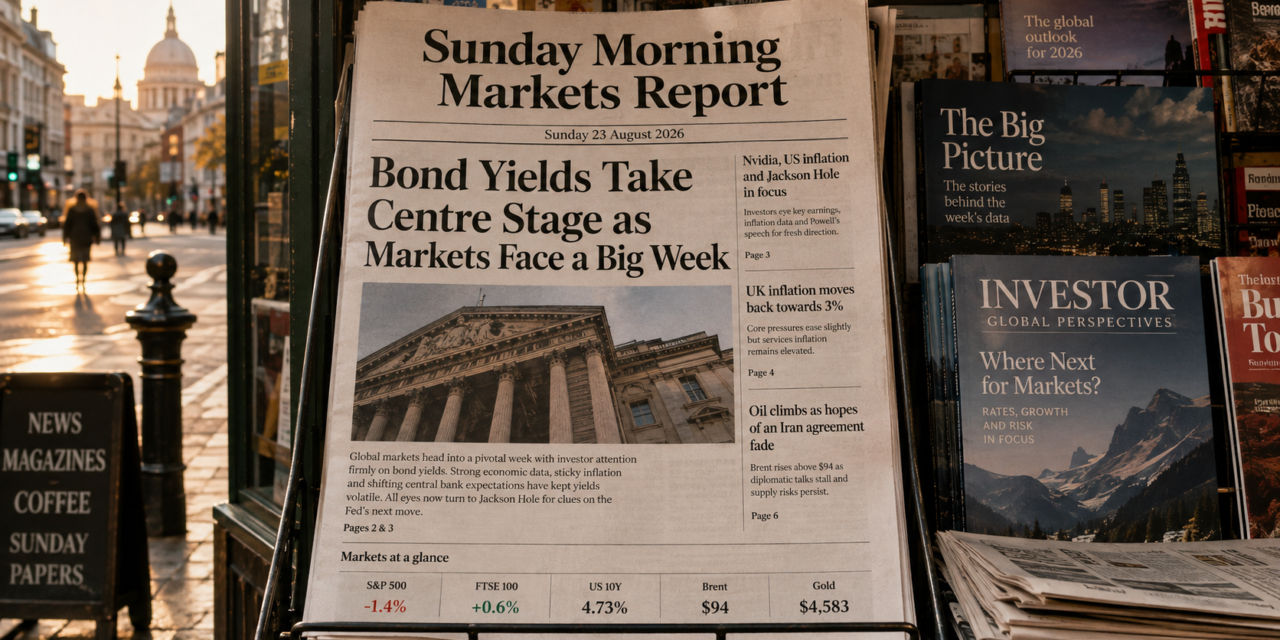
Bond Yields Take Centre Stage as Markets Face a Big Week
The S&P 500 and Nasdaq ended three-week winning runs, with the Nasdaq falling 2.1% and semiconductor shares particularly weak. The FTSE 100 moved the other way, helped by mining companies. Brent crude gained 6.4%, while long-dated US government bond yields touched levels not seen since 2007.
S&P 500
-1.4%
Last week
FTSE 100
+0.6%
Last week
US 10-year gilt
4.73%
Last week
Brent Crude
$94
Last week
The big picture
The bond market has taken control
Last week’s most important moves weren’t in shares. They were in government bonds.
US long-term bond yields surged as investors worried about inflation, rising government debt and the cost of financing heavy investment in artificial intelligence. The 30-year Treasury yield climbed above 5.3%, prompting the US Treasury to announce larger buybacks of long-dated bonds in an attempt to improve trading conditions. The relief lasted barely a day.
This matters because a higher bond yield affect almost every other asset. It increases borrowing costs, provides investors with a more attractive alternative to shares and reduces the present value of future corporate profits.
That sets up the coming week. Investors now want answers to two questions: will inflation force interest rates higher, and can AI profits justify the extraordinary investment being made in the sector?
Last week: Three things that mattered
1
Bond yields surged and the US Treasury stepped in
The US 30-year Treasury yield reached its highest level since 2007 as investors demanded greater compensation for lending to the US government.
There are several reasons. Inflation remains above target, the federal debt has passed $40 trillion, and government interest payments have risen sharply. At the same time, technology companies are borrowing heavily to finance AI infrastructure.
On Wednesday, Treasury Secretary Scott Bessent unexpectedly doubled planned buybacks of some longer-dated bonds. Yields initially fell and gold jumped more than 3%, but the effect quickly faded.
Why this matters: bond markets are effectively setting the cost of money for the wider economy. If long-term yields stay around current levels, highly valued shares face a tougher hurdle and financing large AI projects becomes more expensive.
2
UK inflation moved back towards 3%
July UK inflation rose from 2.6% to 2.9%, mainly because household energy bills increased after the energy price cap rose by 13%. The Bank of England had expected 2.8%.
There was better news beneath the headline figure. Services inflation eased from 3.6% to 3.4%, while wage pressures appear to be cooling.
Investors therefore didn’t treat the figure as an immediate reason for the Bank of England to raise interest rates. Even so, markets continue to price some chance of another increase this year, helping sterling climb to around $1.37.
Why this matters: UK investors now have an unusual combination of inflation near 3%, Bank Rate at 3.75% and 10-year gilt yields around 5%. That makes bonds more attractive, but it also means borrowing costs remain uncomfortable for households, government and businesses.
3
Oil climbed again as hopes of an Iran agreement faded
Brent crude rose for six consecutive sessions and gained 6.4% over the week, briefly approaching $95 a barrel.
The reason was geopolitical rather than economic. Hopes of an agreement that would fully reopen shipping through the Strait of Hormuz faded, while Washington threatened tougher sanctions against Iran and its trading partners.
Oil is becoming an increasingly direct influence on financial markets.
Higher crude prices feed into petrol, transport, manufacturing and household energy bills. That can keep inflation elevated even while underlying economic growth softens.
Why this matters: if Brent moves decisively above $100 and stays there, central banks may find it much harder to reduce interest rates. Bonds would probably suffer first, followed by expensive areas of the equity market.
This week: What investors should watch
Nvidia: Wednesday’s biggest company event
Nvidia reports second-quarter results on Wednesday 26 August. Few individual companies now have the ability to influence global markets quite as much.
The semiconductor sector fell roughly 5% last week, partly because rising bond yields raised questions about the cost of financing the AI build-out. Nvidia itself has become a proxy for spending across data centres, chips, networking and AI software.
Investors won’t simply look at last quarter’s profit. They will focus on orders, margins and what Nvidia says about future AI infrastructure demand.
Another strong outlook could revive technology shares. Any sign that customers are slowing expenditure could affect companies across the AI supply chain.
US inflation and growth: also Wednesday
Wednesday is unusually busy. The US Bureau of Economic Analysis will publish July’s PCE inflation figure, alongside a revised estimate of second-quarter economic growth.
PCE matters because it is the Federal Reserve’s preferred measure of inflation. The first estimate showed US GDP growing at a 1.5% annualised rate in the second quarter.
Lower inflation coupled with steady growth would be reassuring.
Stronger inflation would raise the probability of another interest-rate increase and could push Treasury yields higher again. Markets currently put the chance of a September increase at roughly 35%.
Jackson Hole: Kevin Warsh’s first big event
Central bankers gather in Wyoming for the annual Jackson Hole symposium between 27 and 29 August.
The main event will be Federal Reserve Chair Kevin Warsh.
Minutes from July’s Fed meeting showed that several policymakers were already prepared to raise rates, while many believed higher rates could eventually be necessary if inflation didn’t fall.
Warsh has deliberately reduced the Fed’s use of detailed forward guidance. That makes his words harder for markets to anticipate and, potentially, more influential.
A clear commitment to controlling inflation could lift bond yields. Greater concern about employment or growth would probably have the opposite effect.
Why long-term bond yields matter so much
Central banks set short-term interest rates. Markets set long-term borrowing costs.
That distinction matters. A government, company or household borrowing money for ten or thirty years cares far more about long-term yields than about what the Federal Reserve might do at its next meeting. Those yields also influence mortgage rates, corporate borrowing and the rate investors use when valuing companies.
Consider a technology business expected to earn much of its profit ten years from now. When safe government bonds yield 2%, investors may accept a high price for those distant profits. At a Treasury yield approaching 5%, they demand more.
There’s another change worth recognising. Bonds now offer a level of income that investors haven’t seen for much of the period since the financial crisis.
UK investors can obtain yields of around 5% from parts of the gilt market without taking equity risk. That doesn’t mean selling shares and buying bonds. Equities remain the main source of long-term capital growth.
It does mean that bonds can once again perform the job they were supposed to do in a diversified portfolio: provide income, return capital at maturity and offer a genuine alternative to equity risk.
Five Things I'll Be Watching
1. Nvidia: Its outlook will tell us whether AI investment demand is still accelerating.
2. US PCE inflation: A hotter number could quickly revive expectations of higher US interest rates.
3. Jackson Hole: Kevin Warsh has an opportunity to give markets a clearer picture of how he thinks about inflation.
4. US 10-year Treasury yield: Another move towards 5% would put pressure on expensive shares.
5. Brent crude: A sustained move above $100 would alter the inflation outlook considerably.
Final thought
Last week’s sell-off was relatively modest, but it told us, bond yields, and inflation affect what investors are prepared to pay for future profits.
Next week brings plenty of headlines, especially around Nvidia and the Federal Reserve.
Bonds yields may go higher, but at these levels yields do appear attractive, it is worth checking what exposure you have here.