🌟 Peace Hopes, Rate Fears and Tech
Global markets experienced a fascinating tug-of-war this week. The main event was the diplomatic progress in Geneva, where a formal peace agreement regarding the transit routes through the Strait of Hormuz was signed. This effectively removed a massive “geopolitical risk premium” from the energy markets, triggering an relief rally in oil-importing regions—most notably sending Japan’s Nikkei 225 index surging to five consecutive record-breaking daily closes. However, equity euphoria was abruptly checked mid-week by a distinctly hawkish Federal Reserve meeting. The central bank made it clear that persistent domestic economic strength means interest rate cuts are being pushed much further down the road, with policymakers even acknowledging the potential need for another hike before the end of 2026. This dynamic sent the US dollar skyrocketing to a one-year high while keeping European and UK blue chips under distinct pressure.
📈 Weekly Scoreboard
| Index | Weekly Change (%) | Current Level |
|---|---|---|
| S&P 500 | +0.9% | 7,500.58 |
| Nasdaq Composite | +2.4% | 26,517.93 |
| EURO STOXX 50 | +1.7% | 6,293.13 |
| FTSE 100 | -1.0% | 10,363 |
| Nikkei 225 | +7.6% | c.71,250 |
| MSCI Emerging Markets | +4.1% | 1,786.22 |
| China (SSE Composite) | +1.5% | 4,090.48 |
Note: US markets were closed on Friday for Juneteenth, so US figures reflect Thursday’s close. China markets were also closed on Friday for the Dragon Boat Festival.
🌍 Global Drivers
- US–Iran peace deal eased geopolitical risk and oil prices. A deal and reopening of the Strait of Hormuz helped push oil sharply lower, which in turn supported equities by reducing inflation fears and transport costs.
- Central banks stayed hawkish, but markets shrugged. The US Federal Reserve signalled fewer rate cuts via its “dot plot”, yet the S&P 500 still logged its 11th gain in 12 weeks as investors focused on resilient growth and strong tech earnings.
- Tech and semiconductors led the charge. The Nasdaq outperformed as chipmakers rallied on news that Intel will partner with Apple on domestic semiconductor production, reinforcing the long-term “onshoring” and AI themes.
- Falling energy prices supported Europe. Cheaper oil lowered input costs for European companies, helping the EURO STOXX 50 to another positive week despite ongoing uncertainty around future rate paths.
🇬🇧 UK Corner
- The FTSE had a difficult week. The FTSE 100 fell around 1.0%, while the FTSE 250 slipped around 0.5%. Miners were weak, while oil majors such as BP and Shell were helped by firmer crude prices later in the week.
- The Bank of England held Bank Rate at 3.75%. The vote was 7–2, with two members wanting a hike. That tells us inflation worries have not disappeared, even though the Bank is trying not to over-tighten.
- Retail sales were stronger than expected. UK retail sales rose 1.2% in May, helped by better weather. Good news for the consumer — but one strong month does not remove the pressure from higher prices, tax and borrowing costs.
🏦 Asset Movers
- GBP/USD: Sterling finished around $1.32, but was down over the week as the dollar stayed strong and UK rate expectations cooled. For UK investors, a weaker pound can lift overseas holdings when converted back into GBP.
- Oil: Brent crude ended close to the $80 area. Lower oil helps the inflation story, but this remains a fragile market because geopolitical headlines can change the price quickly.
- Gold: Gold had another weaker week as a firmer dollar and higher-rate expectations reduced demand. Gold can still be useful as a diversifier, but it does not move in a straight line.
📰 Key Headlines
- Reuters: The US-Iran formal memorandum of understanding was signed in Geneva via Pakistani mediators, officially restoring unhindered commercial maritime traffic through the Strait of Hormuz.
- Financial Times: Global investors rapidly increased bullish dollar positions as the “US Exceptionalism” trade returned, pushing the currency to its highest collective level in over twelve months.
- BBC Business: UK consumer retail sales rebounded by 0.5% in May, indicating steady domestic high street activity despite borrowing costs remaining at multi-year highs.
- Bloomberg: Goldman Sachs revised its year-end global gold price target downward to $4,900 per ounce, citing diminished near-term safe-haven premiums and a structurally stronger US dollar.
- Nikkei Asia: Japan’s core consumer inflation rate held completely steady at 1.4% for May, aligning perfectly with consensus estimates and relieving immediate pressure on the Bank of Japan to hike rates aggressively.
📑 Companies Reporting
Oracle (ORC) — Tuesday: Reported an impressive 15% acceleration in cloud infrastructure revenue; the stock surged 8.2% on the week, providing a strong positive read-across for global enterprise software and database management segments.
Adobe (ADBE) — Thursday: Beat conservative headline earnings estimates and raised full-year digital media annualized recurring revenue guidance; shares gained 6.4%, demonstrating that corporate adoption of generative design tools is converting directly into net margin growth.
Tesco (TSCO): Dropped nearly -3.0% following its Q1 trading update. While headline domestic sales grew, its core UK like-for-like sales growth of 1.8% missed the market consensus of 2.3%, dragged down heavily by internal wholesale underperformance in its Booker division.
⚖️ Investor Sentiment
Volatility (VIX) – The US VIX is trading around the high‑teens (roughly 16–17), well below stress levels, signalling that markets expect only modest near‑term swings.
AAII bull–bear spread – Recent AAII data show bullish sentiment still above its long-term average, but down from earlier peaks as more investors shift to “wait and see” mode.
CNN Fear & Greed Index – Earlier this year, the index dipped into “extreme fear”, but has since moved back toward the middle of the range, pointing to a more balanced risk appetite rather than outright panic or euphoria.
Taken together, these indicators suggest a cautious Risk‑On backdrop: investors are still willing to hold equities, particularly big US tech, but are more selective and less euphoric than a few months ago. Fund-flow data and platform statistics show continued buying into US and UK equities by retail investors, while flows into more cyclical or China-focused funds remain subdued.
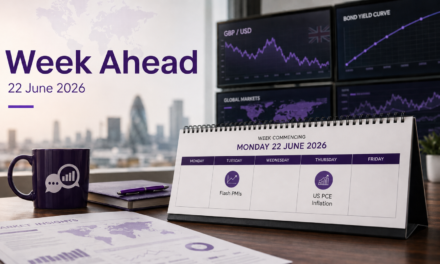
📅 Next Week’s Radar
UK Sovereign Gilt Auction — Tuesday 10:00 UK: The Debt Management Office will issue new multi-billion long-dated gilts; watch this closely to gauge domestic institutional demand and structural yield stability.
US Flash Manufacturing & Services PMI — Wednesday 14:45 UK: A vital leading health indicator for the world’s largest economy; numbers tracking significantly above 52.0 will amplify the Fed’s hawkish rate narrative.
Bank of England Monetary Policy Summary — Thursday 12:00 UK: While no structural base rate change is expected, the committee’s voting split and accompanying language will heavily dictate the near-term direction of the pound and domestic mid-caps.
US Core PCE Price Index — Friday 13:30 UK: The Federal Reserve’s absolute preferred gauge of consumer inflation; any hotter-than-expected print here will completely cement higher-for-longer yields.
⚡ The Final Take
This week served as a textbook reminder that geopolitical relief and monetary policy often move in completely opposite directions. While the resolution of critical shipping bottlenecks has single-handedly unlocked massive hidden value in energy-sensitive regions like Japan, it simultaneously allows Western central banks to keep their focus entirely on fighting sticky core domestic demand.
© Clearly Investments Ltd. Educational information only. This is not investment advice.