
Updated 7 August 2026
To start investing you need an Investment Platform, where you will buy, sell and hold your investments, getting the right one for you will depend on what you are looking to do. Here we consider some of the most well known and largest platforms.
The clear message from this review is: there is no single best platform. There is a best platform for a particular type of investor. So it is thinking what you want to do and then picking the right one for you.
The need-to-knows
- Start with the account, not the platform. Most UK investors should consider an ISA or pension before a taxable General Investment Account.
- Compare the total cost. Include platform charges, fund fees, dealing costs, foreign-exchange charges and bid-offer spreads.
- Match the platform to your portfolio. A platform designed for ETFs may be useless if you want traditional funds, investment trusts or individual shares.
- Large and small portfolios need different pricing. Percentage fees often suit smaller portfolios; fixed fees can become attractive as your investments grow.
- “Commission-free” does not mean completely free. Fund charges, ETF costs, spreads, taxes and currency charges can still apply.
Start with the right tax wrapper
Before comparing apps and dealing charges, decide which account you need.
Stocks & Shares ISA
For most DIY investors, this is the starting point. You can contribute up to £20,000 in the 2026/27 tax year, with no UK income tax or Capital Gains Tax on investments held inside the ISA. Since April 2024, you can contribute to more than one ISA of the same type during a tax year. However, your combined subscriptions must remain within the overall allowance.
Self-Invested Personal Pension
A SIPP can provide tax relief on pension contributions and tax-free investment growth. But the money is normally locked away until minimum pension age, and most withdrawals are taxable. If you are approaching retirement, check that the platform supports drawdown, regular income payments and flexible withdrawals at a reasonable cost.
General Investment Account (GIA)
A GIA is normally considered after using available ISA and pension allowances. Dividends, interest and realised capital gains may be taxable, and selling investments to rebalance or transfer your portfolio can create a Capital Gains Tax liability.
Understand the different costs
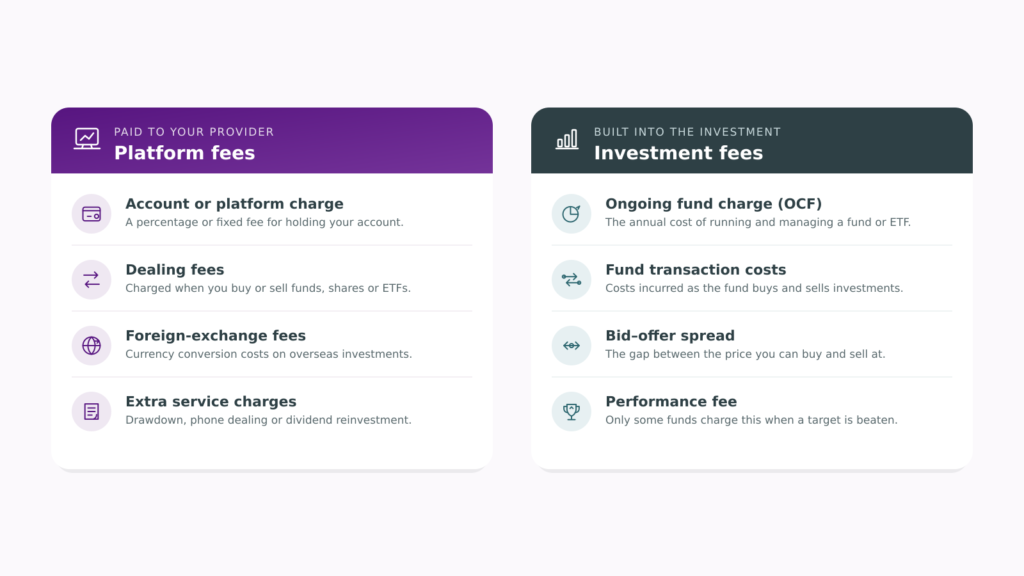
Do not compare platforms using one headline percentage. Check:
- Platform fee: The charge for holding your investments.
- Investment charge: The fund or ETF’s ongoing charges figure, or OCF.
- Dealing fees: What you pay to buy, sell or rebalance.
- Foreign-exchange fees: Charged when dealing in overseas investments or converting currencies.
- Other costs: These can include dividend reinvestment, pension drawdown, telephone dealing and bid-offer spreads.
A platform charging 0.25% costs £25 a year on £10,000, but £625 on £250,000 unless the fee is capped. This is why fixed or capped charges usually become more important as your portfolio grows.
My top investment-platform shortlist
1. AJ Bell — best all-round platform
AJ Bell is my strongest all-round choice for someone wanting funds, ETFs, investment trusts, shares, bonds and gilts in one place.
Its ISA platform charge is 0.25%. Charges on shares, ETFs and investment trusts are capped at £42 a year in an ISA and £120 in a SIPP. Online trades cost £5 for shares and £1.50 for funds, while regular monthly investing is free. See AJ Bell’s current ISA charges.
Positive points
- Excellent investment range.
- ISA, SIPP, Lifetime ISA, Junior ISA and dealing accounts available.
- Competitive capped charges for ETFs, shares and investment trusts.
- Good research, educational material and customer support.
- Free regular investing.
Negative points
- The percentage charge on traditional funds can become expensive on a large portfolio.
- One-off dealing fees matter if you trade frequently.
- Foreign-exchange charges start at 0.75% on smaller overseas deals.
Verdict: A very good default choice if you want flexibility without paying premium-platform prices.
2. InvestEngine — best for a simple ETF portfolio
InvestEngine is a strong option for someone building a diversified portfolio entirely from ETFs.
There are no InvestEngine platform or dealing fees on DIY ISAs, SIPPs or General Accounts. The ETFs still have their own charges and bid-offer spreads. InvestEngine explains its current costs here.
Positive points
- No platform charge for DIY portfolios.
- No dealing commission.
- ISA and SIPP available.
- Automated regular investing and portfolio rebalancing.
- Which? Recommended Provider and Great Value provider.
Negative points
- ETFs only: no traditional OEIC funds or individual shares.
- Less suitable for investors wanting investment trusts, gilts or specialist holdings.
- A smaller and less comprehensive service than the major full-range platforms.
Verdict: Probably the most compelling low-cost choice for a disciplined, ETF-only investor.
3. Trading 212 — best for low-cost shares and ETFs
Trading 212 offers an ISA, SIPP and General Investment Account with no platform fee, custody fee or dealing commission. Its main direct charge is a 0.15% foreign-exchange fee. See Trading 212’s current charges.
Positive points
- No platform or dealing charges.
- Low foreign-exchange charge.
- Wide range of shares and ETFs.
- Fractional shares, automated investing and an easy-to-use app.
- Particularly attractive for regular, smaller investments.
Negative points
- Does not offer traditional open-ended funds.
- Trading 212 also offers high-risk CFD trading through a separate product. Which? does not recommend the provider for this reason.
- Investors wanting extensive research or telephone support may prefer a traditional platform.
Verdict: Excellent value for shares and ETFs, provided you stay firmly within the investment account and avoid CFDs and unnecessary trading.
4. Scottish Widows Share Dealing — best for a large buy-and-hold ISA
Formerly known as iWeb, Scottish Widows Share Dealing charges no annual fee for its ISA or Share Dealing Account.
UK share and fund trades cost £5, while regular investing is free. Its SIPP costs 0.25% a year, capped at £198. See the current Scottish Widows charges.
Positive points
- No annual ISA platform fee.
- Broad range of funds, shares, ETFs, bonds and gilts.
- Free regular investing.
- Particularly economical for larger, low-turnover portfolios.
- Which? Recommended Provider.
Negative points
- The 1.5% foreign-exchange charge is expensive.
- No interest is paid on cash in the ISA or dealing account.
- The service and research offering are more basic than AJ Bell or Hargreaves Lansdown.
- The SIPP is less competitive than the ISA.
Verdict: A strong choice for a substantial ISA containing investments you intend to hold for many years.
5. Interactive Investor — best flat-fee platform
Interactive Investor is particularly interesting for investors with larger portfolios who want an ISA, SIPP and General Account under one fixed subscription.
Its Core plan costs £5.99 a month for portfolios up to £100,000. The Plus plan costs £14.99 a month for larger portfolios. Core trades cost £3.99, while regular investing is free. See Interactive Investor’s current plans.
Positive points
- Fixed charges do not rise continuously with your portfolio.
- ISA, SIPP and dealing account included in one plan.
- Very broad investment range.
- Good research and portfolio tools.
- Useful family-account benefits on higher plans.
Negative points
- The monthly fee is expensive for a small portfolio.
- Dealing charges are additional.
- Foreign-exchange charges start at 0.75%.
- No Lifetime ISA.
Verdict: Worth considering for a larger mixed portfolio, particularly where you want both an ISA and SIPP.
Two other platforms worth considering
Vanguard Investor
Vanguard remains a simple option for investors happy to use only Vanguard funds and ETFs. However, self-managed accounts below £32,000 now cost £4 a month. Above this level, the charge is 0.15%, capped at £375. See Vanguard’s current fee structure.
It is easy to understand and suitable for a simple passive portfolio, but the £48 minimum annual charge makes it less competitive for very small accounts.
Hargreaves Lansdown
Hargreaves Lansdown is attractive for its service, research, app and extensive investment range. Its charges were revised in March 2026.
The main account charge is now 0.35%. Charges on shares, ETFs and investment trusts are capped at £150 in each ISA, SIPP or Fund and Share Account. Fund trades cost £1.95 and standard share trades cost £6.95. See the revised HL charges.
It remains a good premium-service platform, but investors should decide whether they will use the extra support enough to justify the cost.
Do this now: your platform action plan
- Choose the wrapper: ISA, SIPP, Lifetime ISA, Junior ISA or GIA.
- Write down what you intend to hold: Funds, ETFs, shares, gilts or investment trusts.
- Estimate your activity: Include monthly contributions, rebalancing and overseas trades.
- Calculate the cost in pounds: Use your actual portfolio size and expected number of trades.
- Check service features: App, telephone support, research, income withdrawals and pension drawdown.
- Check FCA authorisation and FSCS eligibility.
- Review the choice annually: Platforms regularly change their prices and services.
Note: Do not confuse platform failure protection with protection against investment losses. Client investments should normally be held separately from the platform’s own assets. If there is nevertheless a shortfall and you have an eligible claim, FSCS investment protection is currently up to £85,000 per person, per authorised firm. The newer £120,000 limit applies to eligible bank deposits, not investment claims. Check the FSCS investment rules here.
The bottom line
For a full-service platform, AJ Bell is the strongest all-round choice. For an ETF-only portfolio, InvestEngine is difficult to beat on price. Trading 212 is highly competitive for shares and ETFs, while Scottish Widows Share Dealing suits a large, low-turnover ISA. Interactive Investor becomes more attractive as a mixed portfolio grows.
The best platform is ultimately the one that lets you hold the right investments, inside the right tax wrapper, at a fair total cost—without encouraging you to trade more than you need to.
This article provides general educational guidance, not personal financial advice. Investments can fall as well as rise, and you may get back less than you invest. Charges and tax rules can change.