STARTING INVESTING
Should You Invest a Lump Sum or Spread It Over Time?
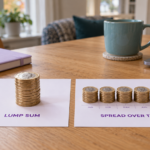
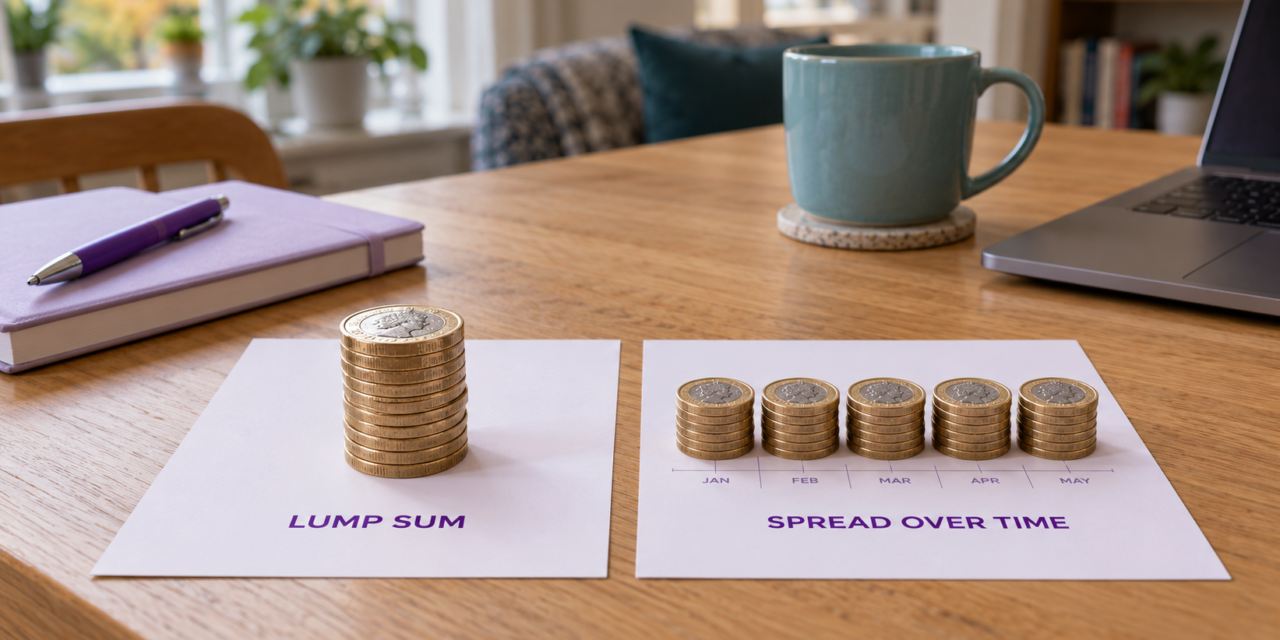
You have money ready to invest, should you invest this all at once or phase this into the market over time?
What do the odds actually tell us?
This guide is to help you decide if you should invest your money at once or if you should spread your investment over a number of months.
The short answer
Over the long term markets have risen so research favours investing the lump sum straight away.
But over the short term markets have a high probaility of falling, so if it would concern you that your money has fallen initially, you should think about phasing the investment.
What is important is that you remain invested, you are looking for the best option, which will keep your money invested for the long term.
What are the chances of finishing ahead?
Vanguard’s 2023 research compared investing immediately with splitting the same amount into three equal payments, one month apart. It measured wealth after one year across rolling historical periods.
How often did the lump sum beat phasing?
| Share market tested | Lump sum finished ahead |
|---|---|
| Global developed shares, in sterling MSCI World, 1976–2022 |
67.8% |
| UK shares, in sterling FTSE All-Share, 1986–2022 |
68.1% |
Source: Vanguard. These comparisons assumed no interest on cash awaiting investment.
“Finished ahead” doesn’t mean “made money”. Both approaches could lose money, with one losing less.
The financial reason is straightforward: investing immediately gives the whole sum exposure to returns. Phasing helps when prices fall during the buying period; if they rise, your later payments buy fewer units.
If the market is at record highs does this change the answer?
A record high tells you that an index has never closed at a higher level. It doesn’t tell you whether company profits justify that level, or what will happen next. Price and valuation are different. Shares can reach a new high because profits have grown, while an index below its peak can still look expensive relative to earnings.
Citi’s analysis of the S&P 500, using data from 1960 to July 2025, found broadly similar average returns over the following one, three and five years after record highs compared with other starting days.
Those are US-market averages, within the data, some individual starting dates still produced painful losses.
“I'll buy after a 10% fall” has a catch
Waiting for a fall can leave you paying a higher price.
Suppose a fund rises from £100 to £120, then drops 10%: it still costs £108, which is 8% more than when you first considered investing.
You may also miss dividends while you wait. And when a fall finally arrives, bad news often comes with it, making you hesitate again and postpone the purchase you’d planned.
Will you actually buy when the fall arrives?
While you may be waiting for a fall in the market before investing, markets usually fall for a reason.
A recession scare, banking problem or war can make the lower price feel more dangerous than the higher price did.
March 2020 shows the difficulty. The S&P 500 reached its pandemic low on 23 March, the same date the UK government announced its stay-at-home restrictions. Not many people were brave enough to buy on that date, but this was actually a god time to buy.
Investors couldn’t know the bottom had arrived. They faced a health emergency and uncertainty about jobs and company survival.
Researchers who surveyed Vanguard investors during the crash found that they became more pessimistic about short-term stock returns after prices fell, and perceived a greater chance of further extreme declines.
Our practical conclusion: if your buying rule also requires reassuring news, you may struggle to act. By the time confidence returns, prices may already have recovered. Not every fall rebounds as quickly as 2020 did.
Separate the evidence from emotional comfort
Vanguard’s explanation of the trade-off recognises that phasing can reduce the damage from a sharp early fall, while tending to sacrifice returns in other conditions.
Two different reasons to choose
Evidence: lump-sum investing has the stronger historical record for finishing with more money.
Emotional comfort: phasing reduces the amount exposed at the outset and may make it easier to proceed without abandoning the plan after an early loss.
That comfort has a practical value if the alternative is leaving everything in cash or buying and then panic-selling. It doesn’t establish that phasing produces better investment returns.
Phasing also has a condition: you must keep making the scheduled purchases during bad news. If you stop after prices fall, you lose the chance to buy the remaining units more cheaply.
Once the whole amount is invested, both routes face the risk of the portfolio you chose. Completing your final payment just before a crash offers no lasting protection.
Choose the portfolio before the payment schedule
Start by deciding how much you can invest and what mix of assets suits your needs. Buying a suitable diversified portfolio immediately doesn’t mean putting every pound of savings into shares.
Imagine a 20% fall turning £60,000 into £48,000. That’s a stress test, not a maximum possible loss. If you couldn’t afford that outcome, review the amount or the portfolio’s risk before choosing an entry schedule.
If the portfolio suits you and you can accept an immediate fall, investing the lump sum is the evidence-led starting choice. If the first purchase feels too difficult, choose a short, fixed phasing period with a firm completion date. Extending the schedule keeps money uninvested for longer.
Check dealing charges and the interest on cash awaiting investment. Also distinguish paying cash into an ISA or pension from buying investments inside it; contribution rules and allowances still apply, whichever purchase schedule you choose.
Finish with a written contribution plan
If I can leave you with one piece of advice it is to have a plan.
Don’t just wait for markets to fall. A useful plan states what you’ll do when markets rise and when they fall and includes dates.
“I’ll invest when things feel calmer” will likely fail.
© Clearly Investments Ltd. Educational information only. This is not investment advice.