QUICK READ
The short answer
Start with your goal and timescale, not a fund or an app. Keep short-term and emergency money in cash. For money you can leave invested for the long term, choose an appropriate account, a diversified investment and a platform that is clear and fairly priced.
- Protect the near term. Don’t invest money you may need soon.
- Match risk to real life. Consider both how you feel about losses and what you can afford.
- Prefer a plan you can maintain. Simple, diversified and low-cost can be a sensible starting point.
Before you invest: will you need this money?
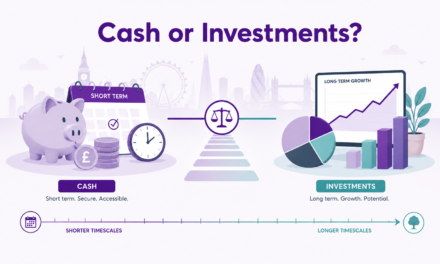
Start with a simple question: When might I need this money?
If it’s your house deposit for two years’ time, next year’s university fees or money you might need if you lose your job, investing it in the stock market probably isn’t sensible.
Share prices can fall sharply and many years of experience has told me, it doesn’t work to your timetable. You don’t want to find yourself needing to withdraw some money, just as your investment has fallen.
The FCA suggests thinking in terms of at least five years for stock-market investing, because a longer period gives investments more opportunity to recover after falls. Five years isn’t a magic number and it doesn’t guarantee a profit. But it is simply a useful starting point.
You should also consider expensive debts and building accessible emergency savings before investing. For many households, keeping around three to six months of essential expenditure in readily accessible savings can provide that emergency reserve.
Money you may need soon belongs in cash. Money you can leave alone for years can be considered for investment.
Understand how much investment risk you can take
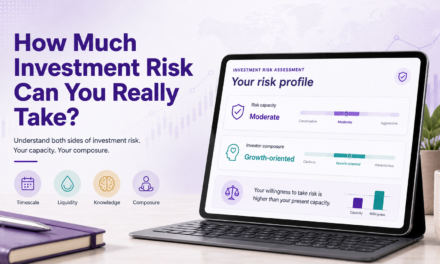
Being comfortable with risk and being able to afford risk are different things.
We have a separate article to help you consider your what return and risk to take with your investments. Our Investments Risk Assessment looks at these two areas separately.
Risk capacity asks what would happen to your finances if investments fell. It considers whether a loss would damage your financial plans.
Investor composure asks how you are likely to react when markets fall.
Suppose you invest £20,000 and six months later it’s worth £16,000.
Could you leave it invested without changing your financial plans? And perhaps just as importantly, would you?
Someone may feel comfortable taking investment risk but have little financial capacity to absorb a loss. Another investor may have plenty of financial capacity but know that a 20% market fall would make them sell everything.
We recommend you look at these two measures because being willing to take risk and affording to take a risk are different. Our assessment also considers your investment knowledge and experience.
You consider your own view of risk, take the Clearly Investments risk assessment
Be realistic when making an investment, your investment should fit your circumstances rather than chasing a return. This sounds simple, anyone who has faced a loss in their investments will tell you how important it is.
DECIDE | TYPE OF ACCOUNT
Choose the right account: ISA, pension or taxable account
Next, separate two decisions that new investors often mix together.
The account holds your investment. The fund is the investment.
You might therefore hold exactly the same investment fund inside an ISA, pension or taxable investment account, but the tax treatment and access to your money can be very different.
| Account | Main benefit | What to think about |
| Stocks & Shares ISA | Investments grow free of UK Income Tax and Capital Gains Tax | Flexible access. The total ISA allowance is £20,000 for 2026/27 |
| Pension / SIPP | Pension contributions can receive tax relief and investments grow within the pension | Mainly for retirement. Access is normally restricted until at least age 55, rising to 57 from April 2028, subject to protections and exceptions |
| General Investment Account | No ISA or pension contribution limit | Investment income and capital gains can create tax liabilities |
The ISA allowance remains £20,000 in 2026/27.
For pensions, the standard annual allowance is £60,000 in 2026/27, although the amount can be lower in some circumstances. Tax relief on personal contributions is also subject to earnings rules. Most people can’t normally access pension benefits before 55, with the normal minimum pension age scheduled to rise to 57 from 6 April 2028.
If you’re employed, don’t overlook your workplace pension, particularly if your employer will contribute more when you contribute more.
A General Investment Account doesn’t provide the same tax shelter. Capital gains can become taxable, with the individual Capital Gains Tax annual exempt amount currently £3,000 for 2026/27.
For a new investor, when you need access to the money should play a large part in this decision.
View our complete guide to investing in an ISA.
Decide how you’re going to invest
Purchase the shares of individual shares in different global markets
Active managers or Managed Investment funds
Index funds or Exchange Traded Funds which track a particular index
But you don’t need to make your first investment complicated. For someone making their first investment, we favour starting with one diversified multi-asset fund that matches the level of risk you have decided they can take.
A diversified fund might own hundreds of different investments across many countries. A multi-asset fund can include shares, government and corporate bonds and, depending on the fund, other assets.
These funds can spread money across these investments, reducing reliance on the success or failure of any single company or asset.
A more cautious fund might hold a larger proportion in bonds and a smaller proportion in shares. A higher-risk version might invest most of the portfolio in global equities.
Many multi-asset funds also rebalance automatically. If shares rise strongly and become too large a proportion of the portfolio, the fund adjusts its holdings towards its intended mix.
For a first-time investor, that’s attractive. One investment can provide the asset allocation, diversification and ongoing rebalancing.
It also removes the temptation to keep changing funds simply because something new hasn’t performed well recently.
Choosing a simple investment solution
For first time investors, we are recommending a simple approach. The next job is choosing the particular fund.
Don’t start by finding the fund with the best return over the last year. Yesterday’s winner isn’t necessarily tomorrow’s.
Start with what the fund owns.
- How much is invested in shares? This will usually be the main driver of how much the fund rises and falls.
- Where does it invest? Look for broad exposure rather than dependence on one country, sector or small group of companies.
- What does it cost? Look at the fund’s ongoing charge and any other material costs. Fees come directly out of your investment return; the FCA advises investors to compare them.
- How is it managed? Some funds mainly track markets using index funds; others employ managers to make active investment decisions.
- Does the asset mix actually fit you? A cheap fund isn’t a good choice if its risk is far higher than you’re comfortable taking.
Read the fund factsheet rather than relying on its name.
Words such as balanced, cautious or growth can mean different things at different fund companies. Look at the percentage invested in shares and bonds.
And remember an easy distinction: a global equity index fund can be very diversified across companies, but it is still a 100% share portfolio.
For someone wanting a mixture of shares and bonds, a multi-asset fund may therefore be the simpler starting point.
Decide if you want to invest it all at once
Suppose you have some money ready to invest. Do you invest the whole amount today or invest across a period of time.
Investing the lump sum gets all your money into the market immediately. If you’re investing for many years and you can probably tolerate any short-term falls.
Drip-feeding means investing gradually. That can make starting psychologically easier because you don’t face the possibility of committing everything the day before a market fall.
My advice is if you feel you will say invested, if the market falls, then invest the money on day one. Over the longer term the market has risen and there is a higher probability that the market will raise rather than fall.
If you feel concerned about the market, and would worry if you saw the value of your investment below the amount you invested, then create a plan to add the money in. If you do create a plan, add dates to the plan, just waiting for the market to fall, can leave you waiting for a long time. I have learned this point from bitter experience.
Choose the platform that will hold your investment
Once we have decided what you are doing, you can think about the investment platform or how you are going to hold your investments.
We have added this in as the final step as you can now select a platform based on what you are looking to do. If you do look at different providers these are the type of things you should look for:-
- Platform charges. Work out what they mean in pounds for the amount you intend to invest.
- Fund availability. Check your chosen fund is actually offered.
- Regular investing. If you’re investing monthly, look at the charges and minimum contribution.
- Administration and service. A low fee isn’t much consolation if transferring money or dealing with a problem becomes difficult.
- Transfer and dealing charges. Check what you’ll pay when buying, selling or eventually moving elsewhere.
- Regulation. Check the provider using the FCA Firm Checker or Financial Services Register before sending money.
Costs matter, but don’t choose on cost alone. You want a platform you understand, that offers the account and investments you need, at a sensible price.
To help you select an investment platform, we have written a guide to choosing an Investment Platform.
YOUR NEXT STEP
Before choosing an investment, complete the Clearly Investments Risk Assessment. It takes around three minutes and looks separately at your financial capacity for loss, investor composure and investment experience.

Clearly Investments is an educational investment blog.
Navigate
Resources
Start Here
Investing
Personal Finance
Markets
Retirement
ABOUT US
The views expressed on this website are for educational purposes only. This is not investment advice.
© Copyright Clearly Investments 2026.