INVESTING
How to choose ready-made investments
A ready-made investment lets you buy a diversified portfolio through one fund. You choose a level of risk; the fund manager chooses the investments and maintains the mix. That can remove much of the work of investing.
This guide explains how ready-made funds work and gives you six options in each of three broad risk groups. The buy list is a shortlist to compare, rather than a ranking or a recommendation tailored to you. You would normally choose one core fund that suits your plan; buying all six in a group adds considerable overlap.
What are ready-made investments?
Typically a ready-made investment is multi-asset fund which holds a mix of shares, bonds and other investments. These maybe a fund of funds which owns other funds to create that mix.
For example, a single holding might give you exposure to US, UK, European and emerging-market shares, alongside government and corporate bonds. The fund manager buys the building blocks and rebalances them as markets move.
We have researched individual funds you can search for on a fund platform. It focuses on six established ranges: AJ Bell, Vanguard, HSBC, BlackRock, Fidelity and L&G. It is not a survey of every ready-made product on the market, but is designed to give you ideas, where you can start.
Why use a ready-made fund?
A portfolio built around an asset allocation
The split between growth assets and defensive assets has a major effect on the experience of investing. Shares offer long-term growth potential but can fall sharply. High-quality bonds can moderate some equity losses, although bonds also lose value when interest rates rise or borrowers get into difficulty.
A ready-made fund combines those assets in a defined process. It also spreads money across markets and securities, reducing your dependence on a handful of companies. Diversification reduces concentration; it cannot remove market risk.
This detail matters. An 80% bond fund is not automatically safe: long-dated government bonds, high-yield corporate bonds and emerging-market debt behave differently. A GBP share class describes the unit’s currency; it does not mean every overseas investment is hedged back to sterling.
Rebalancing without repeated decisions
If shares rise faster than bonds, a fixed-allocation portfolio becomes more equity-heavy. Its manager can sell some shares and buy bonds to restore the intended mix. You avoid doing the arithmetic and placing several trades yourself.
There are two broad approaches in this list. Vanguard LifeStrategy and Fidelity Multi Asset Allocator keep broadly fixed strategic allocations. AJ Bell, HSBC Global Strategy, BlackRock MyMap and L&G Multi-Index allow more active adjustment of the mix. Several active allocators still use inexpensive index funds underneath. Buying trackers does not make the overall allocation passive.
Less administration
One core fund is easier to buy monthly, monitor and maintain than a collection of separate holdings. That can help you stick to a plan. You still need to review your goal, time horizon and ability to bear losses as your circumstances change.
The tax benefits, and their limits
Rebalancing inside the fund
One of the benefits of a ready made fund, is the taxation.
In a taxable investment account, selling one of your own funds to buy another can realise a capital gain. When a single ready-made fund rebalances its underlying holdings, you have not sold your units. That trade does not itself create a personal capital-gains disposal for you.
This can simplify tax records and let the manager rebalance without repeatedly using your personal capital-gains allowance. It is a timing and administration benefit, not a promise that your investment is tax-free. Selling your units, including switching into a different ready-made fund, can create a taxable gain. A managed service trading separate funds in your taxable account can also create disposals in your name.
Use the right wrapper
A Stocks and Shares ISA shelters your investment income and capital gains from UK tax. That benefit comes from the ISA and applies to other eligible investments too. A pension such as a SIPP may provide contribution tax relief and shelters investment growth, but access is restricted and withdrawals can be taxable.
Accumulation units are not a tax exemption
Accumulation units reinvest income within the fund. Income units distribute it to you. Outside an ISA or pension, reinvested income can still be taxable; the distribution may be treated as interest or dividends depending on the fund. Keep the fund’s tax vouchers and the records needed to adjust your acquisition cost.
A single fund also gives you less control over where individual assets sit. With separate holdings, you may be able to put interest-paying assets in a tax shelter or realise gains and losses selectively. Simplicity has a trade-off.
How to compare the review list
Start with allocation and process, then check costs and performance. Our low, medium and high labels are groups based on the funds’ current mix and mandates. They are not a common official risk score, the funds typically use different risk indicators.
The tables show the exact share class researched. One-year returns are total returns; three- and five-year returns are annualised, showing an equivalent yearly rate. Income is reinvested, returns are in sterling and fund-level charges are reflected in the provider’s performance figures. Platform fees, personal tax and inflation are excluded. Where a factsheet reports cumulative returns, we convert them. Conversion from rounded source figures is approximate.
The ongoing charges figure (OCF) covers recurring fund expenses, including relevant underlying fund costs. It does not capture fund transaction costs and any platform, dealing or advice charges. The current £10,000 fund-cost examples are £17 a year at 0.17%, £20 at 0.20% and £31 at 0.31%. Returns already reflect fund expenses.
Low-risk ready made funds: six funds to compare
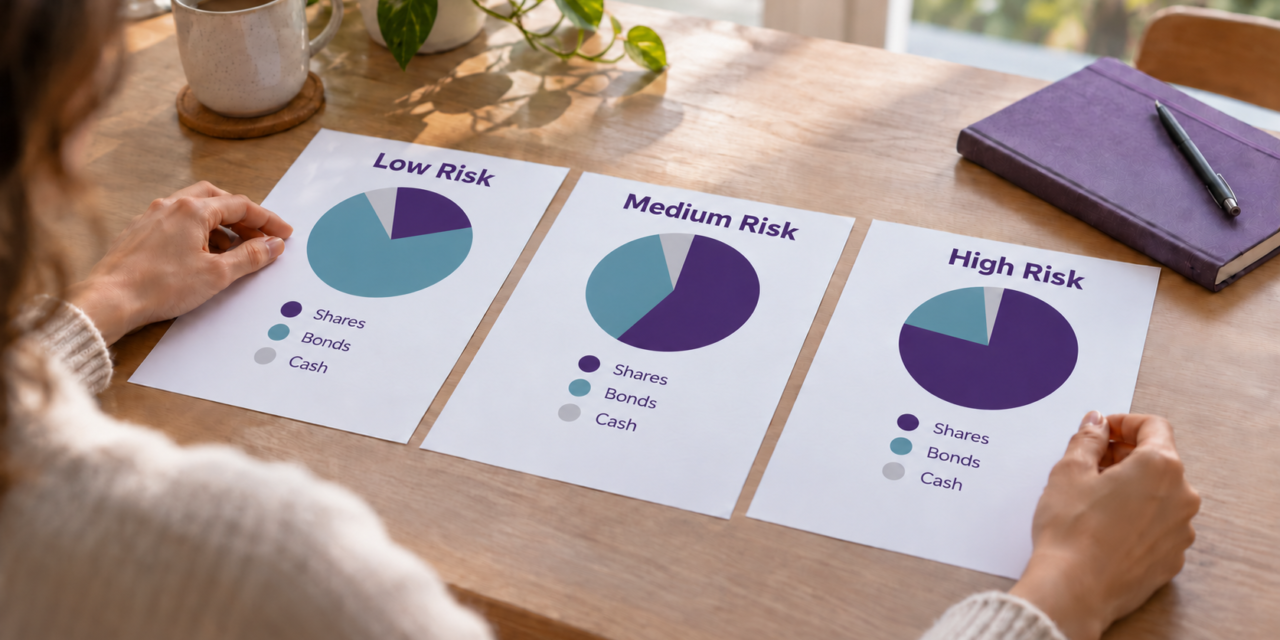
These funds hold roughly one-fifth to one-quarter of their assets in ordinary shares, with much of the remainder in bonds. They may suit investors seeking smaller swings than an equity-heavy portfolio who can still accept losses and invest for at least five years. They are not substitutes for emergency cash.
| Fund | Class | OCF | 1 year | 3 yr p.a. | 5 yr p.a. | Shares |
| CG AJ Bell Cautious | I Acc | 0.31% | 8.62% | 7.06% | 3.11% | 25.9% |
| Vanguard LifeStrategy 20% Equity | GBP Acc | 0.20% | 5.89% | 6.02% | 0.40% | 20.1% |
| HSBC Global Strategy Cautious Portfolio | C Acc | 0.205% | 4.38% | 5.66% | 1.10% | 18.7% |
| BlackRock MyMap 3 | D Acc | 0.17% | 7.45% | 7.43% | 2.65% | 20.8% |
| Fidelity Multi Asset Allocator Defensive | W Acc | 0.20% | 5.20% | 6.35% | 1.40% | 18.2% |
| L&G Multi-Index 3 | I Inc | 0.31% | 7.31% | 6.64% | 1.95% | 22.0% |
Medium-risk ready made funds: six funds to compare
These funds sit in the middle of our selected ranges, but their allocations are not identical. MyMap 4 has about 45% in shares; AJ Bell Balanced has about 62%. Fidelity Growth targets 60% growth assets including listed property. Compare those differences when you are looking at the returns.
| Fund | Class | OCF | 1 year | 3 yr p.a. | 5 yr p.a. | Shares |
| CG AJ Bell Balanced | I Acc | 0.31% | 15.27% | 11.48% | 7.03% | 61.6% |
| Vanguard LifeStrategy 60% Equity | GBP Acc | 0.20% | 13.56% | 11.62% | 5.57% | 60.4% |
| HSBC Global Strategy Balanced Portfolio | C Acc | 0.18% | 12.79% | 11.52% | 6.04% | 57.0% |
| BlackRock MyMap 4 | D Acc | 0.17% | 11.50% | 10.68% | 4.86% | 44.8% |
| Fidelity Multi Asset Allocator Growth | W Acc | 0.20% | 12.30% | 11.25% | 5.55% | 54.5% |
| L&G Multi-Index 5 | I Inc | 0.31% | 15.10% | 11.89% | 6.00% | 56.0% |
High-risk ready made funds: six funds to compare
These funds are dominated by growth assets. They may be considered for a long-term goal where you can absorb substantial losses without needing to withdraw or abandoning the plan. Ordinary shares range from about 72% in Fidelity Adventurous to over 91% in AJ Bell Adventurous. Fidelity also holds 7.7% in listed property; HSBC has substantial listed-property exposure too.
| Fund | Class | OCF | 1 year | 3 yr p.a. | 5 yr p.a. | Shares |
| CG AJ Bell Adventurous | I Acc | 0.31% | 22.84% | 16.27% | 10.91% | 91.1% |
| Vanguard LifeStrategy 80% Equity | GBP Acc | 0.20% | 17.91% | 14.62% | 8.36% | 80.1% |
| HSBC Global Strategy Adventurous Portfolio | C Acc | 0.21% | 19.51% | 15.87% | 9.87% | 84.3% |
| BlackRock MyMap 6 | D Acc | 0.17% | 18.68% | 15.93% | 8.49% | 77.4% |
| Fidelity Multi Asset Allocator Adventurous | W Acc | 0.20% | 16.60% | 13.93% | 7.82% | 72.3% |
| L&G Multi-Index 7 | I Inc | 0.31% | 24.51% | 17.48% | 9.79% | 88.0% |
How to buy a ready-made fund on a platform
Read Clearly Investments’ guide to choosing an investment platform before opening an account. Check that the platform offers your chosen fund and share class, then compare the total charge at the amount you plan to invest. Percentage fees, flat fees, minimum charges and account type can change which platform is cheaper.
The investments in this list are funds rather than exchange-traded shares. You need a platform that deals in these funds. A platform offering only ETFs will not necessarily offer them. A provider’s own platform may also restrict you to its own range.
- Choose the account. Open the appropriate Stocks and Shares ISA, SIPP or taxable investment account, following step three of the seven-step plan.
- Find the exact fund. Search by the name or the ISIN shown below each fund. Check the share class, currency and whether it accumulates or pays income. Similar names can identify different products.
- Read the current documents. Check the Key Investor Information Document or Key Information Document, factsheet, risk warnings, OCF and transaction costs. Confirm the platform’s minimum investment and dealing terms; a large direct-investment minimum on a manager’s factsheet may not apply through a platform.
- Fund the account and place the order. Enter the amount you want to invest, or set up a regular contribution. Use step six to decide whether to invest a lump sum at once or in stages. Many open-ended funds trade at a future valuation point, so you will not know the exact dealing price when you place the order.
- Check and keep the records. Confirm the holding, share class and charge after the trade completes. Keep contract notes and, for taxable accounts, distribution statements and acquisition-cost records.
For example, a 0.20% fund OCF plus a hypothetical 0.25% annual platform fee comes to approximately 0.45%, or £45 a year on a constant £10,000 holding, before transaction and dealing costs. A flat platform fee needs a separate calculation. Use the actual tariff for your account and balance.
Review your choice at least annually and after a material change in your circumstances. Check whether its allocation and process still suit your plan. A disappointing quarter by itself is a weak reason to switch, and switching in a taxable account can create a tax bill.
How we maintain this list
Each quarter we will provide a review of the funds, providing an update on performance and any changes to investments. A fund remains on the list only while its role and process support its inclusion.
Capital is at risk. This article provides general information and a researched comparison, not personal investment advice. The low-risk label is relative to the other investment funds here; it does not mean capital protection. Tax treatment depends on your circumstances and can change.
© Clearly Investments Ltd. Educational information only. This is not investment advice.