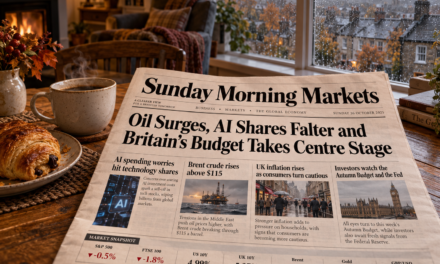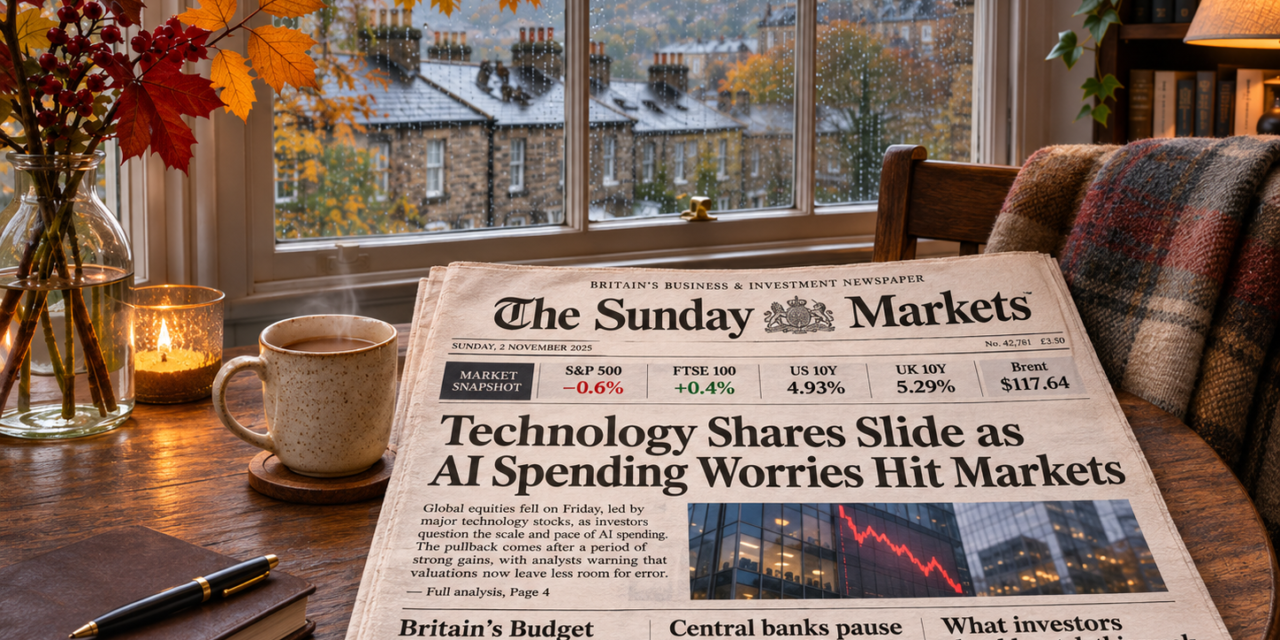
Technology Shares Slide as AI Spending Worries Hit Markets
October ended badly for technology investors. The Nasdaq fell 2.9% on Friday, its largest daily decline since June, and finished the week 2% lower. Intel shares plunged 28.6% following disappointing results, while AMD dropped almost 11%.
Britain held up considerably better. The FTSE 100 gained 0.4% for the week, helped by its lower exposure to technology.
Government bonds provided some protection, with the US 10-year Treasury yield falling below 5%. Gold, however, suffered a particularly sharp decline on Friday.
S&P 500
-0.6%
Last week
FTSE 100
+0.4%
Last week
US 10-year gilt
4.93%
Last week
Brent Crude
$117.64
Last week
The big picture
Investors are questioning the cost of the AI boom
The biggest investment story last week wasn’t the Federal Reserve, Britain’s Budget or even oil approaching $120 a barrel.
It was the growing concern that technology companies are spending too much money on artificial intelligence without generating sufficient financial returns.
Microsoft, Alphabet, Meta and Amazon all faced difficult questions about their enormous AI investment programmes. Intel then delivered a disappointing earnings outlook, sending its shares down almost 29% on Friday.
The result was a sharp sell-off across US technology shares, dragging the wider market lower.
Yet there was a striking contrast. More than 80% of S&P 500 companies reporting earnings have beaten expectations, with third-quarter profits forecast to grow approximately 32%.
Corporate America remains profitable. The problem is increasingly what investors are prepared to pay for that growth.
Last week: Three things that mattered
Big Technology Faces an AI Reality Check
What happened? The major technology companies delivered their quarterly earnings, but investors increasingly focused on spending rather than revenue growth.
Alphabet fell more than 12% on Thursday after reporting disappointing revenue and heavy AI investment that pushed free cash flow into negative territory.
Amazon also reported substantial cash outflows and indicated that capital spending would increase further next year.
Intel provided the week’s most dramatic reaction. Its shares fell 28.6% on Friday, following a weak revenue forecast and warnings about continued cash consumption.
Why markets reacted? Investors are questioning how much capital the technology sector must invest before AI delivers attractive financial returns.
Building data centres, buying advanced chips and securing electricity supplies is expensive. Increasingly, companies are borrowing to finance these investments.
Why this matters? Technology valuations assume substantial future profit growth. If spending rises faster than revenues, those assumptions become harder to justify.
For global index investors, this matters because large US technology companies represent a substantial share of their equity exposure.
Britain’s Budget Avoided a Bond Market Sell-Off
What happened? Chancellor John Healey delivered his first Autumn Budget on Wednesday. Investors had feared that additional borrowing or unexpected tax announcements might trigger another increase in gilt yields.
Instead, the Budget was relatively restrained. Fiscal headroom remained around £15 billion, while the government maintained its borrowing rules. UK 10-year gilt yields eased during the week, finishing around 5.29%.
Why markets reacted? The bond market welcomed the absence of significant surprises.
However, the Office for Budget Responsibility downgraded its forecast for economic growth in 2027, while the Institute for Fiscal Studies warned that the government’s finances leave limited room to absorb future shocks.
Why this matters. For UK investors, the Budget contained several relevant tax announcements.
The government retained the £20,000 Cash ISA allowance, announced future increases in tax rates on savings income and changed certain pension and inheritance-tax provisions. The immediate market reaction was reassuring, but Britain’s underlying fiscal challenges remain.
Central Banks Pause, but Oil Keeps Inflation Concerns Alive
What happened? The Federal Reserve left interest rates unchanged at 3.75–4.00% on Wednesday, while the European Central Bank also held rates steady. Both indicated that inflation remained a concern.
Meanwhile, Brent crude finished the week at $117.64 a barrel, following renewed Middle Eastern supply disruptions.
Why markets reacted? Investors increasingly believe that further interest-rate increases may be necessary if higher energy prices continue feeding into inflation.
Yet government bond yields fell on Friday as investors sought protection from the technology sell-off. The US 10-year yield ended October at approximately 4.93%, well below its earlier peak.
Why this matters Central banks face a difficult combination: slowing employment growth alongside inflation that remains above target.
For investors, the important question is whether rising energy prices create temporary inflation or lead to more persistent increases in wages and other costs.
This week: What investors should watch
1. Tuesday: US Midterm Elections
Americans vote on 3 November in elections that could change control of Congress.
Investors will focus on the consequences for government spending, taxation, trade policy and regulation.
A divided Congress might make major legislative changes more difficult. That could provide some policy stability, although it may also complicate future budget negotiations.
A decisive result giving one party greater control could increase expectations of policy changes.
Technology regulation, healthcare and defence spending are among the sectors where the election outcome could matter.
The market impact will depend more on the policies that follow than on which party wins.
2. Thursday: Bank of England Interest-Rate Decision
The Bank of England meets on 5 November, with Bank Rate currently at 3.75%.
Investors expect policymakers to consider a quarter-point increase as inflation remains above target.
The decision comes just a week after the Autumn Budget, with gilt yields still above 5%.
A rate increase accompanied by cautious guidance could reassure investors that the Bank remains determined to control inflation.
A more aggressive message might push gilt yields higher and put pressure on UK companies sensitive to borrowing costs.
For private investors, the implications extend to mortgage rates, savings accounts, sterling and government bonds.
3. Friday: US Employment Report
The October US employment report arrives on 6 November at 1.30pm UK time.
September produced just 29,000 new jobs, increasing concerns that the labour market may be weakening.
Another poor report would strengthen expectations that the Federal Reserve could pause further increases.
However, a sharp deterioration in employment could also raise concerns about economic growth and corporate profits.
A stronger report might support shares initially, but could push bond yields higher if investors conclude the Fed must tighten policy again.
Watch wage growth and unemployment alongside the headline number.
4. Apple, AMD and Palantir: Another Test for Technology
The technology earnings season continues, with Apple and Palantir reporting on Monday, followed by AMD on Tuesday.
These results will be watched particularly closely after last week’s sell-off.
Apple provides insight into consumer technology demand. AMD offers another perspective on AI semiconductor spending, while Palantir gives investors a view of demand for AI software.
Strong results and convincing profit forecasts could stabilise sentiment.
Disappointing guidance or further increases in spending without corresponding cash generation could extend the technology sell-off.
Investment Insight
AI Growth and Investment Returns Are Two Different Things
Artificial intelligence may change the way companies operate, but that doesn’t guarantee that every business investing in it will deliver attractive shareholder returns.
Last week’s earnings provided a useful reminder.
Technology companies are committing extraordinary amounts to data centres, advanced chips and electricity infrastructure. These investments may ultimately prove highly profitable.
But the money must be spent today, while much of the expected income may not arrive for years.
That creates a financial risk, particularly when borrowing costs remain high.
Consider two companies investing £10 billion in AI infrastructure.
One funds the investment from existing profits and already has customers committed to using its services.
The other borrows heavily, hoping sufficient demand emerges over the next five years.
Both may benefit from AI adoption, but their risks are very different.
Investors should therefore pay increasing attention to free cash flow, debt levels and returns on invested capital, rather than revenue growth alone.
There is also a portfolio lesson.
Global index funds already provide substantial exposure to the largest US technology companies. Adding individual AI shares may increase concentration without providing as much additional diversification as investors expect.
A successful technology doesn’t automatically make every company associated with it a successful investment.
Five Things I'll Be Watching
-
US midterm elections: The outcome could change expectations for taxation, regulation and government spending.
-
Bank of England: Thursday’s decision will influence gilt yields, sterling and UK borrowing costs.
-
US employment: Friday’s payroll figures could alter expectations for the Federal Reserve’s December meeting.
-
Technology earnings: Apple, AMD and Palantir face a market increasingly demanding evidence of financial returns.
-
Oil prices: Brent near $118 remains a serious obstacle to lower inflation and interest rates.
Final Thought
October ended with a sharp reminder that investment expectations can change quickly.
Technology companies continue reporting strong growth, but investors are becoming less willing to overlook the cost of delivering it.
Meanwhile, government bonds offered some protection during Friday’s sell-off, while UK shares performed relatively well.
For long-term investors, diversification remains particularly useful when markets are reassessing a dominant investment theme.
There will always be new technologies, political developments and economic surprises.