Another record high for stocks
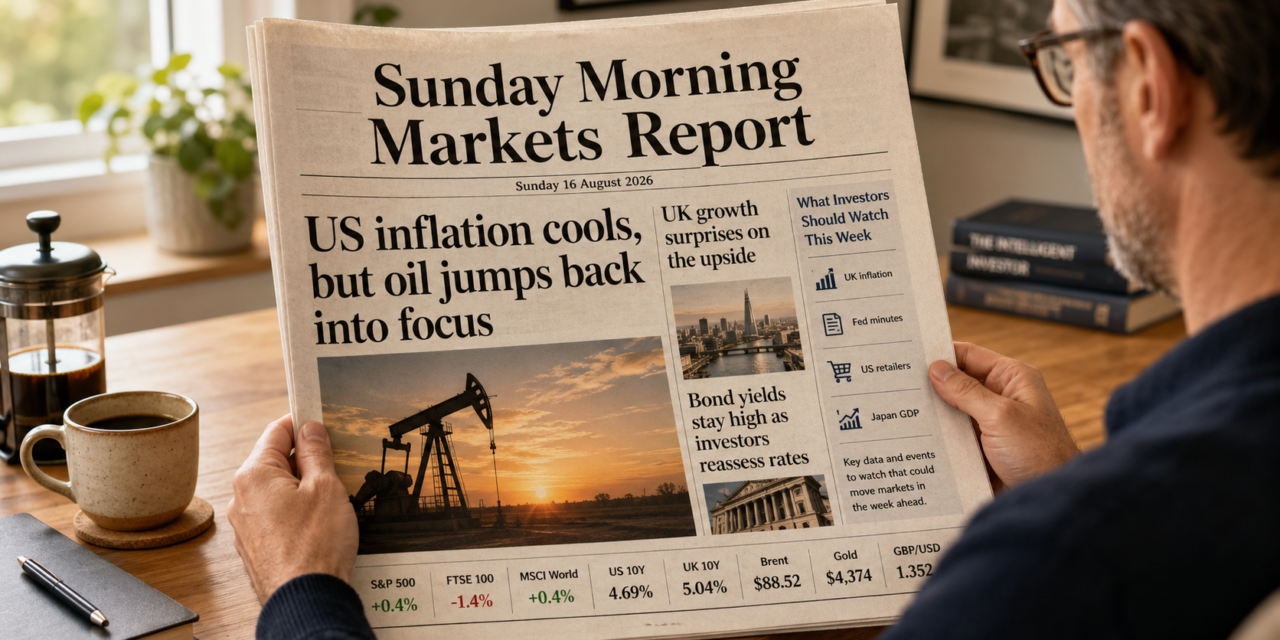
US shares reached another record during the week, although Friday’s pullback left the S&P 500 only 0.4% higher.
Britain moved the other way: the FTSE 100 suffered its first weekly fall in five weeks, with mining shares among the main drags. Oil provided the week’s larger move, with Brent rising roughly 6% as tensions around the Strait of Hormuz returned.
S&P 500
+0.4%
Last week
FTSE 100
-1.4%
Last week
UK 10-year gilt
5.04%
Last week
Brent Crude
$88.52
Last week
The big picture
Inflation is cooling, but investors can’t forget about oil
For much of the week, investors received the combination they had been hoping for. US inflation eased slightly, producer prices stopped rising and corporate profits continued to beat forecasts. That reduced fears that the Federal Reserve would raise interest rates in September and helped the S&P 500 reach another record high.
Then came the reminder that inflation doesn’t follow a straight line. Brent crude climbed back to $88.52, while long-term government bond yields remained high. The US 10-year Treasury ended at 4.69% and Britain’s 10-year gilt around 5.04%.
So what is driving markets right now? Investors are weighing strong profits and softer underlying inflation against expensive shares, high borrowing costs and the risk that energy prices push inflation higher again.
Last week: Three things that mattered
1
US inflation gave the Federal Reserve some breathing room
July’s US Consumer Price Index rose just 0.1% during the month, taking annual inflation down from 3.5% to 3.4%. Core inflation, which strips out food and energy, eased to 2.5%. Producer prices were unchanged during July.
Markets liked the figures because they followed July’s weak employment report. Investors now have more evidence that price pressures and the labour market are cooling together.
By Friday, markets put roughly a 67% probability on the Fed leaving rates unchanged in September.
That matters particularly for growth shares. Lower expectations for future interest rates make profits expected many years from now more valuable today. Yet inflation is still above the Fed’s 2% target, so declaring victory would be premature.
2
Britain’s economy was stronger than expected
UK GDP grew 0.4% in the second quarter, following 0.6% growth in the first three months of the year. June itself surprised, with the economy expanding 0.3% when economists had expected no growth. Services rose 0.4%, helped by consumer spending, the World Cup and better weather.
For investors, stronger growth has two sides.
It reduces fears of a sharp UK slowdown and supports company profits. But it also gives the Bank of England more room to keep interest rates high if inflation remains troublesome. Bank chief economist Huw Pill said the figures strengthened the argument for higher borrowing costs.
Sterling consequently finished the week around $1.35. Attention now switches directly to this week’s UK wage and inflation figures.
3
Oil returned as the market’s inflation problem
Brent crude gained about 6% over the week as attacks on tankers and stalled US-Iran negotiations again raised concerns about shipping through the Strait of Hormuz. Roughly a fifth of global oil supply can normally pass through the waterway.
This matters far beyond oil companies.
Higher energy costs eventually reach households through petrol, transport and utility bills. Businesses face higher distribution and production costs. If those increases persist, central banks have a harder job bringing inflation down.
Oil therefore sits awkwardly beside last week’s reassuring US inflation figures. Current inflation may be easing while the next inflation problem is already developing.
This week: What investors should watch
UK wages and inflation
Tuesday brings the latest UK labour-market figures, followed by July inflation on Wednesday. The previous CPI reading was 2.6%, but renewed energy pressures mean investors will watch closely for signs that inflation has started climbing again.
Lower wage growth and a subdued inflation figure would reduce pressure on the Bank of England. Strong wages combined with higher inflation could strengthen the argument for another rate rise.
That would probably push gilt yields higher and may support sterling, while rate-sensitive areas such as property and smaller companies could find life harder.
US retailers face the consumer test
Home Depot reports on Tuesday, with Walmart, Target, Lowe’s and Deere also reporting during the week.
These results matter more after Friday’s surprising 0.6% fall in July US retail sales, the first monthly decline in nine months.
Investors will listen for evidence that $4-plus petrol, borrowing costs and economic uncertainty are changing household behaviour. If shoppers are trading down towards cheaper products and essentials, company margins could come under pressure even if total sales remain respectable.
Strong trading statements would support the idea that America’s slowdown remains manageable. Widespread caution from retailers would raise harder questions about economic growth.
Federal Reserve minutes
On Wednesday, the Fed publishes minutes from its 28-29 July meeting, when policymakers left rates at 3.50%-3.75%.
Investors already know three officials wanted higher rates. What they don’t know is how close the wider committee is to joining them.
If the minutes reveal deep concern about inflation, Treasury yields could rise. A committee more worried about jobs and growth would strengthen expectations that September brings no change.
Japan moves closer to another rate rise
Japan publishes second-quarter GDP on Monday. Economists expect growth of around 2% annualised, which would mark a third successive quarterly expansion.
That matters because the Bank of Japan is considering raising rates from 1% as soon as September. Reuters reports markets now see a high probability of another increase.
For global investors, Japan matters because years of very low Japanese rates helped finance investment elsewhere. A sustained rise in Japanese yields could gradually pull money back towards domestic assets and influence global bond markets.
Investment Insight: Why bond yields still matter when shares are at record highs
The S&P 500 has reached record territory while the US 10-year Treasury yields almost 4.7%. That combination deserves attention.
A government bond yield represents an alternative return available to investors. When Treasury yields were around 1% or 2%, investors had a strong incentive to accept more risk in shares. At close to 5%, the choice becomes less obvious.
Higher yields also affect how analysts value companies. Suppose two businesses are expected to produce most of their profits at different times. One earns heavily today; the other is expected to make much more money ten years from now. Higher interest rates reduce the present value of those distant profits more sharply, which is why highly valued growth companies can react badly when bond yields rise.
Yet this isn’t an argument for abandoning shares. Company profits have remained strong: around 85% of US companies reporting recently have beaten earnings expectations.
For long-term investors, the lesson is simpler. Bonds once again offer meaningful income, while shares remain the main engine of long-run portfolio growth. A diversified portfolio doesn’t require you to decide which one wins next month.
Five Things I'll Be Watching
1. UK inflation: Wednesday’s figure could reshape expectations for the next Bank of England move.
2. 10-year gilt yield: A sustained move above 5% would increase financing costs across the UK economy.
3. Walmart and other US retailers: Their comments may tell us more about American households than another economic survey.
4. Brent crude: Another surge would quickly revive inflation concerns.
5. Japan: Strong GDP could strengthen the case for a September Bank of Japan rate increase.
Final thought
Markets gave investors plenty to think about last week. US inflation improved, Britain grew faster than expected and company profits remained healthy, yet oil rose sharply and government bond yields stayed high.
None of those developments requires a long-term investor to remake a portfolio on Monday morning.