Nothing to see here
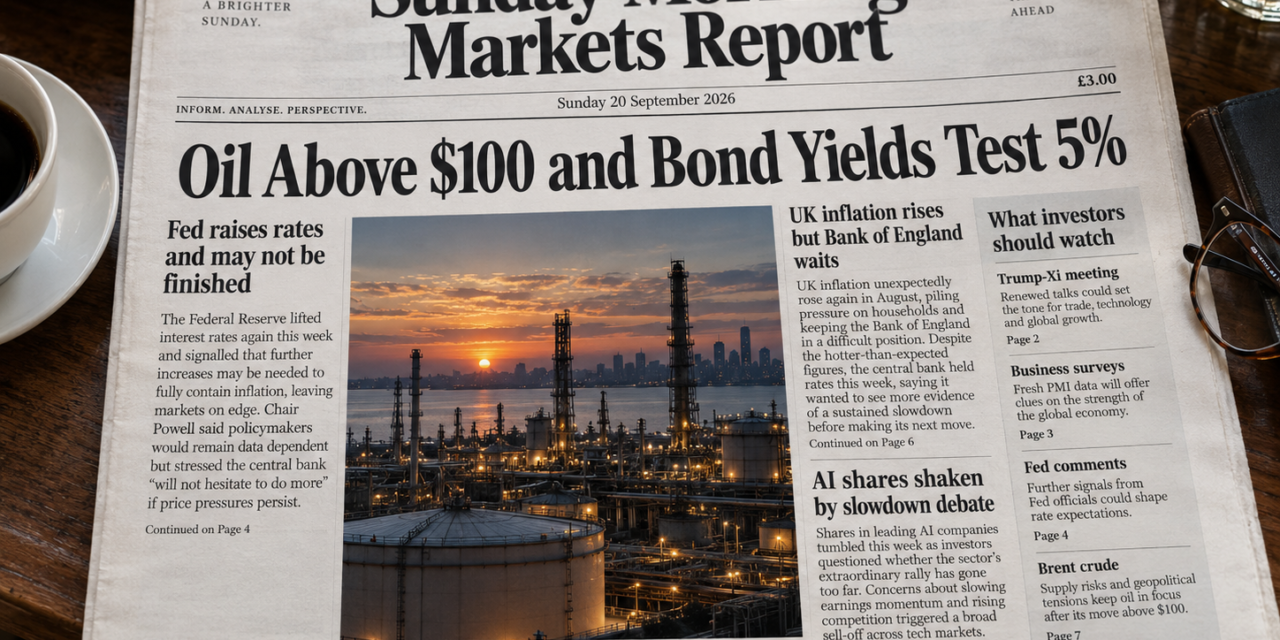
The headline equity markets hardly moved. The S&P 500 slipped 0.1% over the week, the FTSE 100 eked out a small gain and MSCI World fell about 0.5%. Beneath those figures, there was much more going on: the US 10-year Treasury yield reached 5%, sterling fell 1.2% against the dollar, while Brent traded as high as almost $110 before ending at $103.87.
S&P 500
-0.1%
Last week
FTSE 100
+0.1%
Last week
US 10-year gilt
5.00%
Last week
Brent Crude
$103.87
Last week
The big picture
Central banks turn up the pressure as bond yields test 5%
Last week was dominated by interest rates.
The Federal Reserve raised rates for the first time in more than three years. The Bank of Japan followed with another increase, taking its policy rate to 1.25%, its highest in 31 years. The Bank of England held at 3.75%, but three of its nine policymakers wanted an immediate rise.
The common problem is inflation. Oil remains above $100, economies have proved more resilient than expected and central banks are increasingly concerned that higher energy costs could spread into wages and other prices.
For investors, the question has moved on from “when will rates fall?”. Markets are now asking how high borrowing costs may need to go, and whether equity valuations can cope if government bonds continue to offer yields around 5%.
Last week: Three things that mattered
The Federal Reserve raised rates and suggested it may not be finished
The Fed increased its target range by 0.25 percentage points to 3.75%-4.00% on Wednesday. The decision was unanimous. Its statement said economic activity remained solid, spending was resilient and inflation was still elevated.
Markets had expected the increase. What mattered more was the message afterwards.
Fed Chair Kevin Warsh said underlying inflation trends hadn’t improved enough, while the Fed’s projections pointed towards the possibility of another increase. By Friday, futures markets put the probability of an October rise at about 55%, up from 42.5% a week earlier.
The bond market reacted accordingly. The 10-year Treasury yield returned to 5%, a level with consequences well beyond government borrowing. Mortgage rates, corporate financing and the valuations placed on future company profits all take their cue from bond yields.
For shares, strong earnings still provide support. But the higher the risk-free return available from bonds, the more demanding investors can afford to be about the price they pay for equities.
UK inflation rose, but the Bank of England chose to wait
UK CPI inflation increased from 2.9% to 3.1% in August, with petrol and other transport costs making the largest contribution to the rise. Services inflation remained at 3.6%.
A day later, the Bank of England voted 6-3 to leave Bank Rate at 3.75%. Megan Greene, Catherine Mann and Huw Pill preferred an immediate increase to 4%. The Bank warned that inflation could rise further if elevated energy prices persist, although it has seen little evidence so far that the energy shock is feeding materially into wider wage and price setting.
There was another significant decision for bond investors. The Bank changed the way it will unwind the gilts bought under quantitative easing, reducing annual active sales and suspending auctions for several months. Gilt prices rose following the announcement.
For UK investors, 5.28% on a 10-year gilt is now a serious alternative to equity income. It also tells us financial conditions remain tight even though Bank Rate itself didn’t move.
AI shares were shaken by a new question: should development slow?
Monday produced one of the week’s sharpest equity moves.
Calls from senior figures at several leading AI companies for slower development because of safety concerns triggered selling across semiconductor shares. Nvidia fell 3.4%, Micron more than 5%, and the Philadelphia semiconductor index dropped 5.9% in one session.
Technology shares recovered later in the week and the Nasdaq actually finished 0.7% higher, but the episode changed the discussion around AI.
Until recently, investors largely concentrated on whether companies could build enough chips, data centres and electricity generation to satisfy demand. Regulation, safety restrictions and the pace at which new models should be released are becoming financial questions too.
That matters because so much expected capital expenditure and earnings growth across the technology sector now rests on rapid AI adoption.
This week: What investors should watch
1. Thursday: Trump and Xi meet in Washington
Chinese President Xi Jinping is due to meet US President Donald Trump on 24 September. Trade, tariffs, rare-earth supplies, energy and artificial intelligence are among the subjects expected to be discussed. US and Chinese officials have already been holding preparatory talks.
There are discussions over possible tariff reductions covering about $30 billion of trade, including China’s 15% tariff on US liquefied natural gas. No agreement has been announced.
Markets will watch for any change to the tariff truce due to expire in November and any agreements affecting rare earths or technology.
Progress that reduces trade barriers could ease some supply-chain costs. Renewed disagreement would raise questions about tariffs, inflation and technology supply chains.
2. Wednesday: can the economy live with 5% bond yields?
Flash business surveys for the US and other major economies arrive on Wednesday. These give investors an early reading of September activity before most official economic figures are available.
Normally, a strong survey would be welcomed. Right now the reaction may be more complicated.
Strong growth combined with rising prices could reinforce expectations of another Fed increase and keep the 10-year Treasury yield around or above 5%. Weakening activity could bring yields down, although a sharp deterioration would raise concerns about profits.
Watch the survey’s prices and employment components, rather than simply the headline number.
3. What does the Fed say after raising rates?
Fed officials return to the speaking circuit this week following Wednesday’s rate increase. Vice Chair Philip Jefferson and Governor Michael Barr are among those scheduled to speak.
This matters because Warsh has deliberately avoided giving markets detailed promises about future policy.
Investors therefore have less certainty about October than they became accustomed to under previous Fed regimes. Comments suggesting that last week’s increase was enough for now could relieve some pressure on Treasury yields. Further concern about inflation could have the opposite effect.
4. Oil remains the event that isn’t in the diary
Brent ended Friday above $100, despite retreating from its midweek highs.
Developments over the weekend show why markets can’t ignore the region. Smoke and flames were reported near Riyadh airport on Saturday following emergency alerts, while attacks have threatened Saudi Arabia’s alternative Red Sea export route at a time when traffic through the Strait of Hormuz remains restricted.
Any easing of supply fears could help bonds and rate-sensitive shares. Further disruption would put energy prices and inflation expectations back under pressure.
Why raise interest rates when oil is causing the inflation?
Central banks can’t produce more oil, repair a pipeline or reopen a shipping route. So why would the Bank of England or Federal Reserve respond to an energy shock by raising interest rates?
Because they aren’t trying to reverse the first increase in energy prices.
Their concern is what happens next.
Imagine petrol, transport and electricity costs rise sharply. Businesses may raise their prices to recover those costs. Employees may then seek larger wage increases because household bills have gone up. Companies facing higher wages may raise prices again.
A temporary energy shock can then develop into persistent domestic inflation.
Economists call these second-round effects.
The Bank of England says there is little evidence of material second-round effects in the UK so far. But it also says the risk increases the longer energy prices stay high.
That explains why the Bank can leave rates unchanged today while warning that it may have to raise them later.
For investors, it is also why oil, wage growth and bond yields need to be viewed together. One month’s inflation figure tells only part of the story. What matters is whether higher prices start changing behaviour across the economy.
Five Things I'll Be Watching
- US 10-year Treasury yield – Holding above 5% would keep pressure on mortgages, corporate borrowing and expensive shares.
- Trump-Xi meeting – Trade, technology and rare-earth agreements could affect companies well beyond the US and China.
- Brent crude – Oil above $100 remains one of the biggest threats to lower inflation.
- Fed comments – Markets are split over whether October brings another rate rise.
- AI shares – Investors will be watching whether last week’s safety debate has any lasting effect on spending plans or valuations.
Final thought
Last week offered a useful reminder that markets can appear calm while the investment environment is changing underneath.
The S&P 500 barely moved, yet the Fed raised interest rates, the US 10-year yield reached 5%, Britain recorded higher inflation and the debate surrounding AI took another turn.
Shares still provide access to long-term economic and earnings growth. Bonds now provide levels of income that were unavailable for much of the past decade. Holding both, across different markets and sectors, reduces the need to correctly predict what the Fed, oil prices or the next political meeting will do.