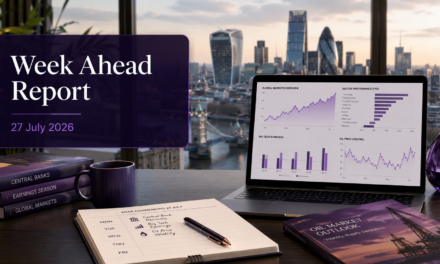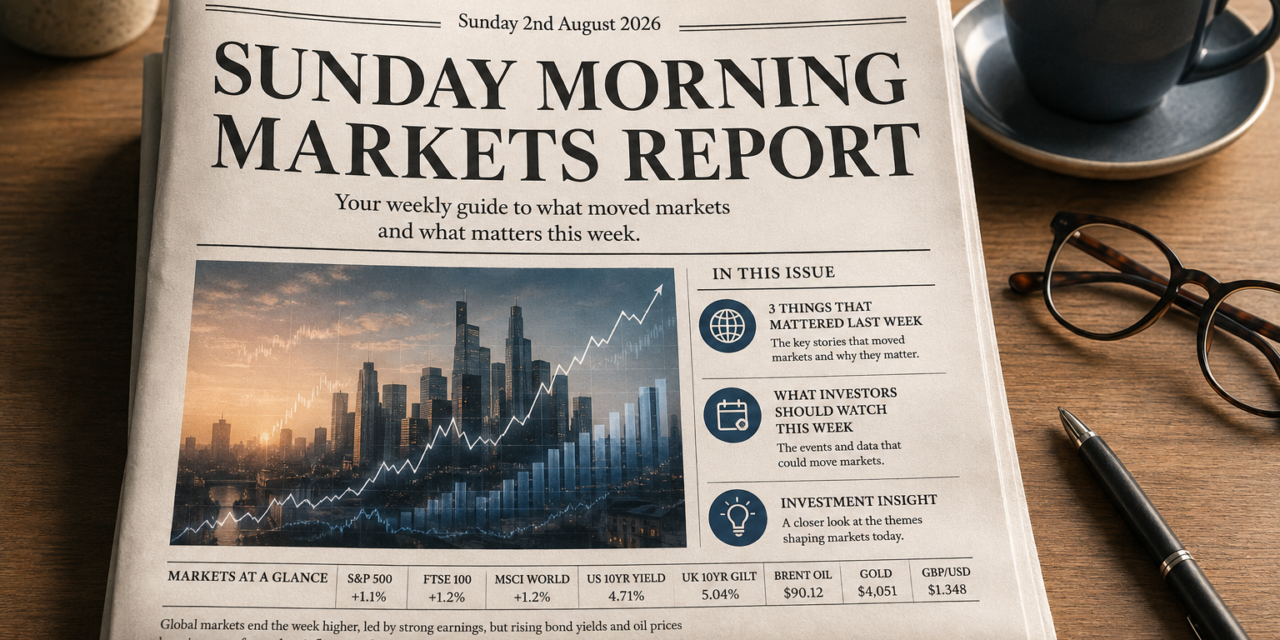
This week we launch a new weekly report which gives you a quick view on what to look out for in the week ahead.
Market in Numbers
| Market | Latest |
|---|---|
| S&P 500 | +1.1% last week |
| FTSE 100 | +1.2% last week |
| MSCI World | +1.2% last week |
| US 10-Year Treasury Yield | 4.71% |
| UK 10-Year Gilt Yield | 5.04% |
| Brent Crude Oil | $90.12 a barrel |
| Gold | $4,051 an ounce |
| GBP/USD | $1.348 |
Figures are based on market levels at the close on Friday 31 July.
The headline index returns concealed some remarkable movements underneath. Microsoft rose more than 15% in one session, Amazon gained a similar amount after its results, while Apple fell 7.4%. Meanwhile, the US 30-year Treasury yield reached 5.25%, its highest level since 2007.
The Big Picture
Earnings rescued shares, but bonds are still flashing a warning
Markets ended the week in better shape than they started it. Strong results from Microsoft and Amazon restored some confidence in artificial intelligence, helping the S&P 500 finish 1.1% higher despite considerable volatility.
However, the more important story may have been in government bonds.
Long-term borrowing costs rose as investors questioned whether inflation was under sufficient control. Oil returned above $90 a barrel, three Federal Reserve policymakers voted to raise interest rates, and the US 30-year Treasury yield reached a 19-year high.
Markets are therefore being pulled in two directions. Corporate earnings remain strong enough to support shares, but persistent inflation and high bond yields are making investors less willing to pay any price for future growth.
That tension will continue to drive markets this week.
Three Things That Mattered Last Week
1. Microsoft and Amazon restored confidence in AI
What happened?
Microsoft reported an 18% rise in quarterly revenue, with Azure cloud revenue growing by 43%. Its shares jumped more than 15% in response. Amazon then reported its strongest cloud growth for more than four years, sending its shares up by a similar amount.
The results contrasted sharply with Apple, which fell 7.4% following a disappointing outlook, and Meta, where heavy investment contributed to concerns about declining free cash flow.
Why markets reacted
Investors have become increasingly concerned that technology companies are spending enormous amounts on data centres and computer chips without generating sufficient returns.
Microsoft and Amazon provided evidence that demand for AI-related cloud services is translating into faster revenue growth.
Why this matters
The market is no longer rewarding every company that announces higher AI spending. Investors increasingly want proof that expenditure is producing revenue, profit and cash flow.
That represents a healthier but more selective stage of the AI investment cycle.
2. The Federal Reserve delivered a “hawkish hold”
What happened?
The Federal Reserve kept its policy rate between 3.50% and 3.75%, but three members voted for an immediate quarter-point increase.
The Fed said economic activity remained solid but acknowledged that inflation was still above its 2% target, partly because of higher energy prices. Investors now see a meaningful possibility that rates could rise at the September meeting.
Why markets reacted
The decision itself was expected. The surprise was the size of the disagreement within the Fed and the lack of clear guidance from Chair Kevin Warsh.
That uncertainty pushed longer-term Treasury yields higher. The US 10-year yield briefly touched 4.75%, while the 30-year yield moved above 5.25%.
Why this matters
Higher government bond yields increase borrowing costs and make bonds more competitive with shares.
They particularly affect highly valued growth companies because more of their expected profits lie many years in the future. When the rate used to value those profits rises, their present value falls.
3. Oil complicated the inflation outlook
What happened?
Brent crude ended the week at $90.12 a barrel as disruption around the Strait of Hormuz and other important shipping routes raised concerns about supplies.
Although oil declined over the week, it rose approximately 24% during July.
The Bank of England consequently faced an awkward policy decision. It kept Bank Rate at 3.75%, but three of its nine policymakers voted for an increase—one more than markets expected.
Why markets reacted
Energy prices influence transport, manufacturing and household bills. A sustained rise can spread through the economy and make inflation harder to control.
Why this matters
The Bank of England still expects underlying inflation pressures to ease, but it believes headline inflation could rise again as higher energy costs feed through.
For UK investors, oil prices now matter not only to energy shares but also to gilt yields, mortgage rates, sterling and expectations for Bank Rate.
What Investors Should Watch This Week
1. Friday’s US employment report
The July employment report is expected to show approximately 83,000 new jobs, with unemployment rising to 4.3%. It will be released at 1.30pm UK time on Friday.
A much stronger figure could increase expectations of a September rate rise, pushing bond yields and the dollar higher while pressuring expensive growth shares.
A weak report could reduce rate-rise expectations, although an unexpectedly sharp deterioration might also revive concerns about economic growth.
The best outcome for markets may be moderate employment growth: neither strong enough to increase inflation fears nor weak enough to suggest recession.
2. The next test for corporate earnings
More than one-quarter of the S&P 500 is due to report results, including AMD, Palantir, Caterpillar and Eli Lilly. SpaceX will also release its first quarterly report since joining the stock market.
AMD and Palantir will provide another test of demand for AI infrastructure and software. Caterpillar offers insight into industrial activity, while Eli Lilly’s figures will help investors assess continued growth in obesity and diabetes treatments.
Strong results could broaden the market recovery. Disappointing forecasts would reinforce the message that investors are becoming less tolerant of high valuations.
3. US business surveys
The US manufacturing and services surveys will provide an early indication of how the economy performed in July.
Investors will focus on new orders, employment and the prices companies are paying. Strong activity combined with rising prices would be uncomfortable for the Federal Reserve because it would suggest the economy can withstand higher interest rates.
Weaker activity and easing price pressures would reduce the likelihood of further tightening.
4. Oil and events in the Middle East
Oil is once again functioning as an economic indicator as well as a commodity.
Any further disruption to shipping could lift crude prices, inflation expectations and government bond yields. De-escalation could provide relief to consumers, airlines, transport companies and central banks.
For markets, the important level is not a particular oil price on one day, but whether Brent remains elevated for long enough to affect business costs and household inflation expectations.
Investment Insight
AI investing is becoming a cash-flow test
The first stage of the AI boom rewarded companies that supplied scarce technology. The next stage rewarded businesses announcing large investment programmes.
The market now appears to be entering a third stage: investors want evidence of financial returns.
Microsoft’s results were well received because rapid Azure growth suggested that businesses are paying to use AI services. Amazon produced a similar response by showing accelerating cloud revenue. Meta received a less favourable reaction because its investment spending was accompanied by weaker cash generation.
This does not mean that the AI opportunity is ending. It means the standard by which companies are judged is becoming more demanding.
For long-term investors, the lesson is to separate an important technology from the price paid for exposure to it. A company can participate in a powerful structural trend and still prove to be a poor investment if expectations are already too optimistic.
Diversification therefore remains essential. The potential winners may include chipmakers, data-centre operators, electricity suppliers, software companies and businesses that use AI to improve productivity. They will not necessarily all succeed at the same time.
Five Things I’ll Be Watching
- US employment: The clearest test of whether the Federal Reserve may raise rates in September.
- The 10-year Treasury yield: A sustained move towards 5% would challenge equity valuations.
- Oil prices: Continued strength would make inflation more difficult for both the Fed and Bank of England.
- AI earnings guidance: Investors increasingly want evidence of returns rather than spending promises.
- Sterling: Currency movements affect the value of overseas investments held by UK investors.
Final Thought
Markets will continue to move between optimism about earnings and concern about inflation, interest rates and geopolitics.
Individual weeks can be dramatic, but successful investing is rarely built on reacting to every headline. It comes from holding a diversified portfolio, maintaining realistic expectations and allowing long-term investment plans time to work.
Understanding why markets are moving is valuable. Feeling compelled to respond to every movement usually is not.